6-to-5 Blackjack: A Low-Paying Table to Avoid
If you see a blackjack table with 6:5, think twice before you sit down.
A 6:5 blackjack table means you receive a smaller payout for having a natural blackjack. Six-to-five tables are rampant out there in the wild. You can’t do much to change which casinos have them, but we can help you understand their purpose (and why you should avoid them), and if you must play at a 6:5 table, which strategies you can use to make the best of it.
What is 6 to 5 in blackjack?
In traditional blackjack, a natural blackjack, i.e., when you hit an Ace and a face card on the first deal, pays 3:2. That means a $10 bet wins $15. Muah. Chef’s kiss.
But in 6:5 blackjack, that same $10 blackjack only wins $12. Bleh. Chef’s grimace.
In this case, the casino is paying you $6 for every $5 you bet. With a 3:2 table, you would be receiving $3 for every $2.
It might not sound like much: Three bucks here, three bucks there. But if someone was secretly stealing your fries one by one, after a few minutes, you’d only have a few left, and someone would be sleeping on the couch.
How Does 6 to 5 Blackjack Affect the House Edge and Player Returns?
The house edge is the mathematical advantage the casino holds over you in the long run.
Traditional 3:2 blackjack carries a house edge of around 0.5% when you use basic strategy correctly. That means you lose about 50 cents for every $100 wagered over time.
But 6:5 blackjack raises the house edge to nearly 2%. That means you now lose closer to $2 for every $100 wagered. Switching to a 6 to 5 blackjack variation can increase the house edge by up to 400%. Yikes!
For example:
- A common 6-deck blackjack game with 3:2 payouts may carry about a 0.62% house edge.
- Change only the blackjack payout to 6:5, and the house edge jumps to roughly 1.97%.
And if the casino also restricts double downs to only 10 or 11:
- 3:2 blackjack: roughly 0.82% house edge
- 6:5 blackjack: roughly 2.18% house edge
If you’ve ever used a 6-foot phone charger but still feel like you only get 5 inches of slack while you’re in bed, then you’ll understand the frustration of 6:5 blackjack tables. Somehow, you’re just not getting what you expected.
Payout Comparison: 6 to 5 vs 3 to 2 Blackjack
3:2 blackjack pays 3 dollars for every 2 dollars bet, while 6:5 blackjack pays 6 dollars for every 5 dollars bet. You don’t need us to tell you that adding just one second to the Five-Second Rule means your dropped food is poison. The same goes for removing $3 per blackjack win, as happens with a 6:5 table.
Let’s say you have a $10 bet:
- 3:2 blackjack: Win $15 profit + get your original $10 back
- 6:5 blackjack: Win $12 profit + get your original $10 back
That’s a $3 difference every time you hit blackjack. That’s one whole potato chip at the airport. It doesn’t sound catastrophic yet, but consider it over time.
Over 100 hands, you might reasonably hit around 5 natural blackjacks. Here’s what happens then:
- 3:2 blackjack: About $75 total profit from those blackjacks
- 6:5 blackjack: About $60 total profit from those blackjacks
That’s a significant $15 difference over the same session. You could almost buy the whole bag of potato chips with that. And nothing changed about the game except the payout for a natural.
Why Do Casinos Promote 6 to 5 Blackjack and What are Common Misconceptions?

Well. Why would Gatorade slyly shrink its bottles but charge the same price? (True story.) Because they assume you won’t notice, and most people don’t.
Casinos use a very similar strategy with 6:5 blackjack. Even though we know better, 6:5 actually sounds better. It has bigger numbers!
Then, consider that single-deck blackjack has the best odds. Most players know this, and casinos know they know. So they slap the “single deck” label on the game like it’s the second coming of sliced bread, with the 6:5 payout in the fine print. That’s the misconception casinos count on.
Community Insights and Reactions to the Growth of 6 to 5 Blackjack
The blackjack community has not exactly welcomed 6:5 blackjack with open arms and a standing ovation. When the public found out that Subway’s footlongs were only 11 inches, the internet practically lynched them.
Internet mobs made their outrage clear. No one would take advantage of them, not casinos nor Subway! A few common reactions popped up.
- Frustration that casinos continue shifting blackjack rules toward higher house advantages while still marketing the game as “player-friendly.”
- Complaints that 6:5 blackjack sneakily punishes newer or casual players who may not yet understand payout math.
- Calls to boycott 6:5 tables entirely and support casinos that still offer traditional 3:2 blackjack payouts.
- Concern that if players keep accepting 6:5 blackjack, casinos will continue normalizing worse rules across the industry.
- General agreement that 6:5 blackjack is best avoided whenever possible.
Even card counters, who normally look for ways to squeeze tiny mathematical advantages out of blackjack, often view many 6:5 games as essentially unbeatable in the long run.
Strategies for Players Facing 6 to 5 Blackjack Tables
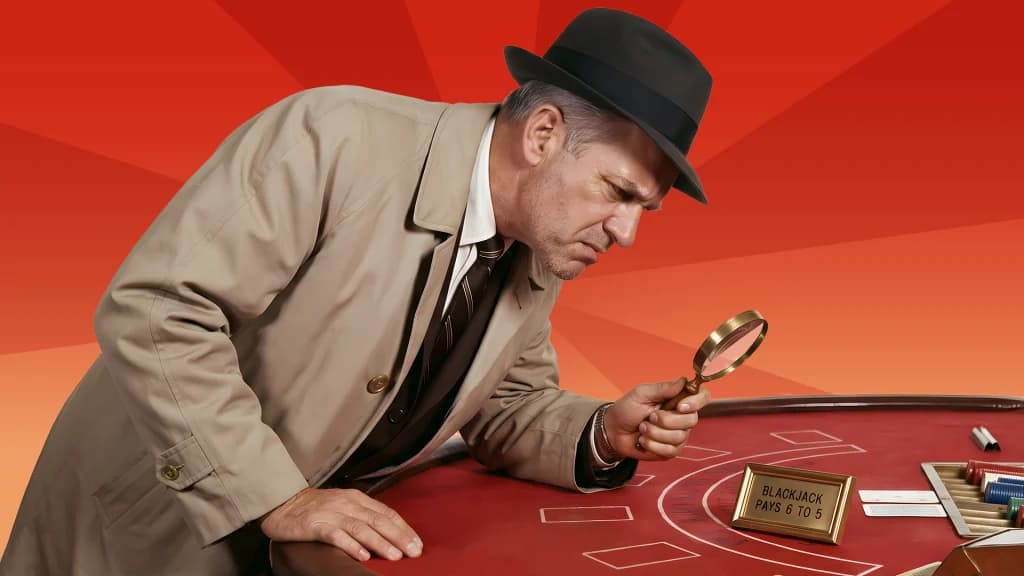
This might be the easiest blackjack strategy ever presented in a guide: when faced with a 6:5 table, avoid it altogether. Done. Refreshments are out back.
Unfortunately, there is no betting system that can change the fact that the table pays you less money for the best hand in blackjack. In fact, the whole reason casinos adopted the 6:5 payout in the first place was to fight back against expert card counters like the MIT Blackjack Team.
The only control you have is to check the rules and decide not to play at a 6:5 table.
Before you sit down, always check the table felt or payout sign. Casinos usually print “Blackjack pays 6 to 5” somewhere on the table, although sometimes the text feels like it’s hiding in witness protection. If you spot 3:2 instead, that’s generally the better choice.
And here’s the part that surprises many newer players: you should usually choose a multi-deck “shoe” game with a proven 3:2 payout over a single-deck game paying 6:5. The better payout matters far more than the lower deck count.
If you absolutely must play 6:5 blackjack because it’s the only open table, use perfect basic strategy as closely as possible and avoid making emotional decisions after losses. Adjust your expectations, and you’ll be fine.
Frequently Asked Questions about 6 to 5 Blackjack
What does 6-to-5 blackjack mean?
It means that for a natural blackjack, you are paid 6 to 5 ($12 profit on a $10 bet). That’s opposed to the standard, higher payout of 3:2.
Is 6 to 5 blackjack better than 3 to 2 blackjack?
No, it’s significantly worse. This subtle payout difference boosts the house edge from about 0.5% to nearly 2%.
When did the shift to 6-to-5 payouts occur?
The change became widespread since the late 1990s, mainly to counter card counting.
Why do casinos use 6:5 payouts?
Casinos use 6:5 payouts to raise the house edge and reduce the player advantage.
Can you beat 6:5 blackjack with good strategy?
Nope. Even if you played perfectly and didn’t make any mistakes, nothing can beat the fact that you simply receive less for a natural blackjack.