
Blackjack Card Values Explained
If you can count to 10, you can understand blackjack card values. In a world of complex strategies involving range balancing and deviation charts, card values in blackjack are mercifully simple.
Still, you might be unsure about face cards or what happens to an Ace. Was it a 10? A 1? 6-7?
The point is, nobody is born knowing blackjack card values, and truthfully, that would be pretty weird. That’s why we’re here to explain card values in blackjack. (An Ace is either 1 or 11, BTW).
Understanding Card Values in Blackjack
Most card values in blackjack are valued based on their given number.
Here’s what cards are worth in blackjack:
Number cards (2-9): Numbered blackjack cards are worth their number. If it looks like a 7, talks like a 7, and walks like a 7, it’s worth 7.
10, Jack, Queen, King: All worth 10 points. The Jack isn’t worth 11 because it comes after 10, and the King isn’t worth more because in Game of Thrones, he has the highest royal rank. They’re all tens, which is easy to remember.
Ace: Worth either 1 or 11, depending on the option that fits your hand best.
The good news is that these card values never change, regardless of the blackjack variation. What might vary, however, are the blackjack rules on payouts, the dealer’s rules, or the number of decks used.
Face Card Values
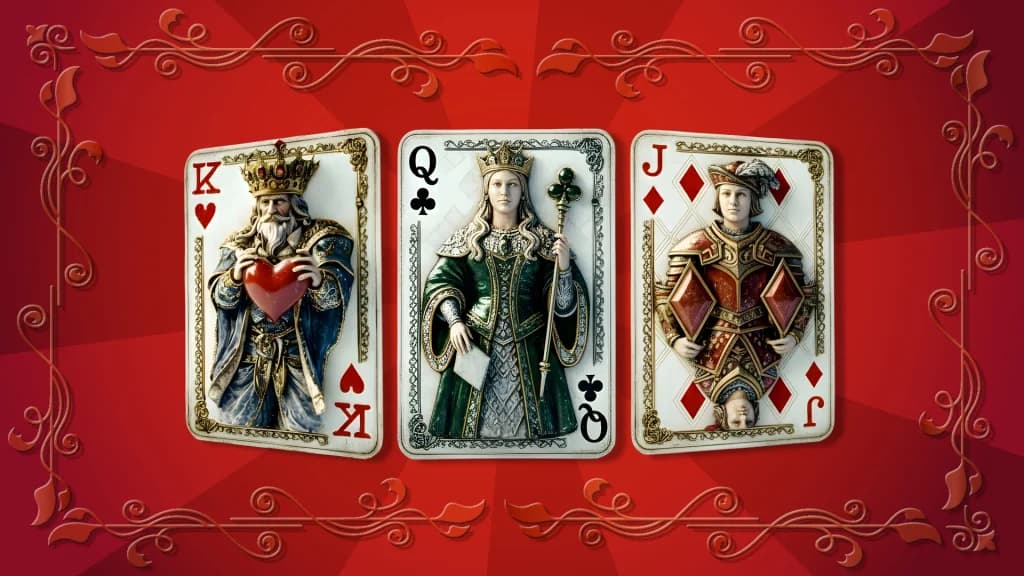
How much is a King worth in blackjack? Ten. How much is a queen in blackjack? Ten. How much is a Jack worth in blackjack, or a 10? The same goes for all—they’re worth ten. Talk about democracy in the deck!
Although it seems like there should be a difference, the only real difference between the King, Queen, and Jack is increasingly fancier crowns, with the King’s being one to rival Queen Charlotte in Bridgerton. But in the blackjack Ton, elaborate crowns don’t matter. The court is only concerned with the blackjack values.
Value of Aces
Now we get to the Ace, which is arguably the most important card of the game.
What is an Ace worth in blackjack? An Ace can be worth 1 or 11, depending on what helps your hand more.
If you’re holding a 6 and an Ace, you could either have 7 or 17. In this case, it’ll automatically be considered a 17 because blackjack always favors the highest hand that’s closest to 21. But if you hit and get stuck with a total over 21 when combined with your Ace, such as a 6-Ace-5, your Ace counts as 1, protecting you from going bust.
It’s like Schrödinger’s Ace. An Ace is worth how much in blackjack? 1 or 11. It’s worth both at the same time, but also worth neither until you see the dealer’s card. The Ace is flexible like that.
Working Out Your Total Hand Value
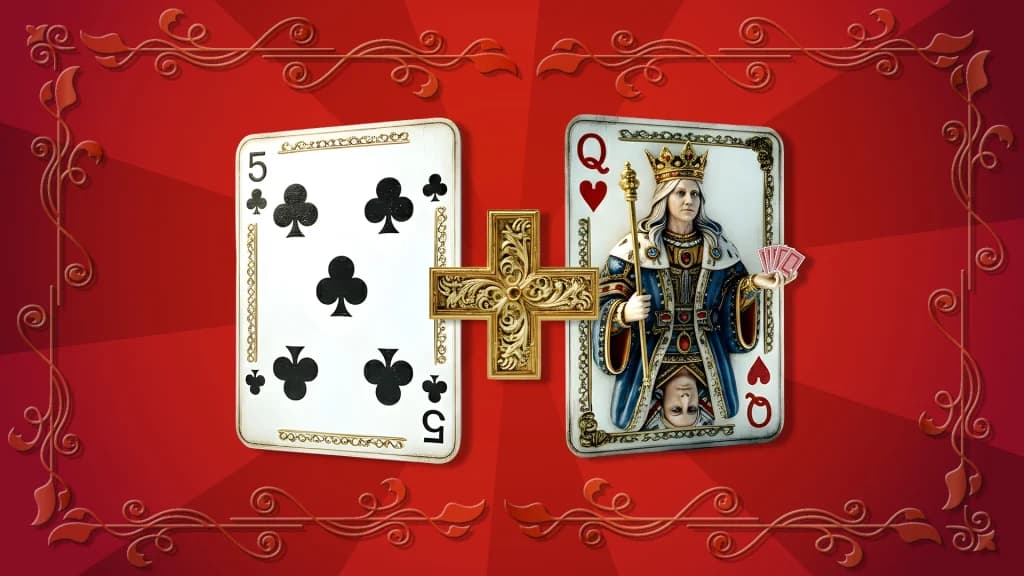
Now that we know the card values, let’s talk about how to add them up, starting with the basics.
Regular Hands
7 + 9 = 16
6 + 4 = 10
8 + 3 = 11
10 + 2 = 12
It’s as simple as that. Add the numbers up, and that’s your total.
Hands With Face Cards
Q + 5 = 15
The Queen is worth 10, so 10 + 5 = 15.
Whenever you see a 10-card or a face value card (Jack, Queen, or King), add ten to your additional card. Let’s look at some more examples.
J + 8 = 18
K + 5 = 15
Q + 10 = 20
J + K = 20
One of the best positions you can be in is having two face-value cards, because that puts you at just under 21.
For the record—since we’re already here—anything with a total of 18 or higher is considered an excellent hand in blackjack, and you should always stand. In the case of the dreaded blackjack 15, however, that’s a special case that depends on the dealer’s upcard.
Hands with an Ace
Remember, the Ace counts as 1 or 11, depending on the best option for your hand. More on soft hands in the following section.
But what happens when you pair an Ace with a face card, like a Jack, Queen, or King, as seen below?
Ace + King = 21
You get the most coveted blackjack hand of all, an automatic 21. That’s what we call a Dr. Bronner’s, Whole Foods, Meryl Streep, Mark Ruffalo, natural. Well, we just call it a “natural.” But you get the point. It means your hand is King and you win a 3:2 or 6:5 payout, depending on the table rules.
Soft Hand vs Hard Hand Values
The examples above cover hard hands, which are hands without an Ace. Soft hands are where players get confused and often make mistakes that keep them up at night, alongside the memory of saying, “Thanks, you too,” when the waiter says, “Enjoy your meal.” We felt that.
But trust us, a soft hand is not as difficult as it sounds, and far less traumatic than the latter.
A soft hand in blackjack refers to any initial hand with an Ace. If, when you hit, you draw a card that would bring your total over 21, the Ace switches to 1 and saves the day. It’s like having a safety net.
Example: Ace + 6 = soft 17. You hit and draw a 9. Instead of busting at 26, your hand becomes 16 (Ace now counts as 1). You’re still in the game because the Ace took one for the team.
A hard hand in blackjack refers to any hand without an Ace. A hard hand has no flexibility. If you’re holding a hard 16 and you draw anything higher than 5, you bust.
Example: 10 + 6 = hard 16. Draw a 7, and you’re done. 9 + 10 = 19. That’s a great hand, and it can’t be changed anyway.
With soft hands, like playing a soft 19 or a soft 16, you can be aggressive because the Ace gives you room to maneuver. With hard hands, your decision is the final move.
Look at you, you’re a natural! And we do mean an Ace-King natural, which is the best kind. Remember, with the value of cards in blackjack, regular cards are valued at their number. The Jack, Queen, and King are all worth 10. And the Ace is worth 1 or 11, depending on convenience. Now, next time we see you at the table, we won’t catch you asking, “Is the Queen worth more than the Jack?” Because now you know—it isn’t. Put your new skills to the test with blackjack at Cafe Casino. We’re counting on you.