Best Craps Strategy: Five Ways to Keep the House Edge Low

- How craps odds work
- Craps strategies compared
- Pass line and come bets
- Managing your bankroll at the Craps table
- Craps stratgies FAQs
This guide hands you five craps strategies, each with its house edge, its character, and who it works for. Pick the one that fits your style and get rolling. Whether you’ve never played before or you’ve got opinions about the Iron Cross, you’ll find what you need here.
Three things run through all of them: keep to low-edge bets, use odds bets wherever the table allows, and sort your bankroll before you sit down. Everything else follows from those.
New to craps? Read craps rules and bets explained first
How Craps Odds Work – and Why They Shape Every Strategy
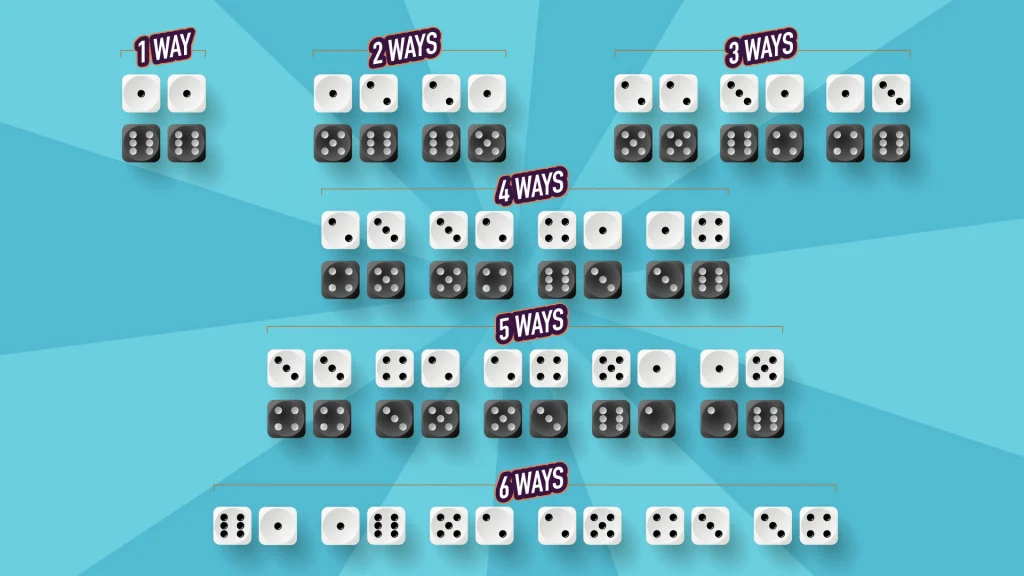
Two dice, outcomes from 2 to 12. But not all of them are equally likely – and that gap is what every craps strategy is built around.
| Roll | Ways to make it |
| 2 | 1 |
| 3 | 2 |
| 4 | 3 |
| 5 | 4 |
| 6 | 5 |
| 7 | 6 |
| 8 | 5 |
| 9 | 4 |
| 10 | 3 |
| 11 | 2 |
| 12 | 1 |
Seven has six ways to land out of 36 possible combinations. It’s the most likely outcome on any given roll, and every craps strategy is either using that or betting against it.
The strategies below are built on one idea: get as close to fair odds as possible. The bets with the lowest house edge are the ones whose payouts come closest to the true probability of each outcome. Proposition bets and hardways sit at 9-16% because the payout is nowhere near fair. Pass Line and odds bets are near zero because they are.
Five Craps Strategies Compared

Here’s how they stack up before we go through each one.
| Feature | Pass Line / Come | 6 & 8 Place | Dark Side | Iron Cross | 3-Point Molly |
| House edge | ~1.41% | ~1.52% | ~1.36% | ~3-5% | ~0.4% with max odds |
| Risk level | Low | Low | Low | Medium-high | Low-medium |
| Best for | Beginners; longer sessions | Players wanting more action | Contrarian, maths-minded players | Wide coverage, short bursts | Systematic, patient players |
| Pays | Even money | 7:6 | Even money | Various | Various |
New to craps? The Pass Line is where to start. Once you’ve got the feel of it, the 6 and 8 add more numbers without costing much extra. If you want the lowest possible house edge and you’re happy running a more structured approach, the 3-Point Molly is the play.
Pass Line and Come Bets
The Pass Line is where almost everyone starts, and with good reason. It runs at 1.41% house edge – one of the best fixed bets in any casino – and the whole table is usually backing it alongside you.
Before the come-out roll, place your bet on the Pass Line. Roll a 7 or 11 and you win immediately. Roll 2, 3, or 12 and you lose. Anything else becomes the point. From there the shooter keeps rolling until they hit the point again – you win – or throw a 7 – you lose.
Once the point is set, you can add an odds bet behind your Pass Line bet. This pays at true odds with no house edge – which makes it the best bet on the table, full stop. The casino earns nothing from it, which is why every table puts a cap on how much you can place. Take the maximum odds every time you can.
Come bets work identically to the Pass Line but can be placed after the point is established. Each one sets up its own mini-game, so you can have several numbers running at once.
If you’re new to craps or you just want a session that goes the distance, this is where to start.
The 6 and 8 Strategy
After the 7, the 6 and the 8 are the numbers that come up most often – five combinations each out of 36. Place bets on both and you collect a 7:6 payout every time either one lands before a 7 shows up.
The house edge is 1.52% – slightly higher than Pass Line’s 1.41%, but the key difference is flexibility. You can place these bets at any point during the game, not just before the come-out roll, and you can pull them down whenever you want.
Pro tip: always bet in multiples of $6 on the 6 and 8. The 7:6 payout only pays cleanly on amounts divisible by 6. A $5 bet pays $5. A $6 bet pays $7. Over a session, that difference is real.
If you want more numbers working without pushing the edge up significantly, the 6 and 8 are the natural follow-on from a Pass Line approach.
The Dark Side Strategy
There’s a type of craps player who quietly backs Don’t Pass while everyone else at the table is cheering the shooter. They take the dagger stares. They don’t care. That’s the Dark Side player.
A Don’t Pass bet wins if the shooter rolls a 7 before hitting the point – the exact opposite of what most of the table is hoping for. At a live table, that can create some atmosphere. Online, there’s nobody watching.
The math actually favours the Dark Side slightly. Don’t Pass runs at a house edge of around 1.36% – a bit lower than the Pass Line’s 1.41%. Once the point is established, the odds tilt in your direction too: a 7 becomes your friend, and since 7 is the most likely roll on any given throw, you’re in a statistically decent position from there.
This isn’t a gimmick or a contrarian pose. It’s a legitimate strategy with a real, if small, edge advantage. The only thing that puts people off at a live table is the social dynamic – which simply doesn’t apply when you’re playing online.
Dark side craps betting strategy – full guide
The Iron Cross Strategy
The Iron Cross covers every number that can roll except the 7. You back the point on the Pass Line, then place bets on 5, 6, and 8. Between those four positions, every other outcome puts money back in your pocket – which feels a lot like printing money a little at a time.
Watch out: the Iron Cross carries a house edge of 3-5%, considerably higher than the other strategies here. When the 7 lands – and it will – all four bets lose in one go. The good runs feel great. The reset does not.
Most rolls aren’t 7s, so you’ll collect frequently. That’s the appeal. But the higher edge and the wipe-everything nature of the 7 make it a short-burst strategy rather than one you run across a whole session. Go in with a clear stake you’re comfortable losing and a plan for when the 7 arrives.
Iron Cross craps strategy – deep dive
The 3-Point Molly
The most structured strategy on this list, and the one with the lowest house edge – around 0.4% when backed with maximum odds. That figure is genuinely exceptional for any casino game. It gets there by combining low-edge base bets with odds bets that carry no house edge at all, dragging the average way down.
Here’s how it runs:
- Place a Pass Line bet before the come-out roll.
- Once the point is established, back the Pass Line with maximum odds.
- Place a Come bet on the next roll.
- Once that Come bet sets its own point, back it with maximum odds too.
- Place another Come bet on the next roll.
- Once that one sets a point, back it with maximum odds.
Now you have three numbers running simultaneously – the Pass Line point and two Come bet points, all backed with max odds. When any of them rolls, you collect. When a bet resolves, replace it with a new Come bet to keep three active at all times.
The 0.4% figure only works if you’re actually loading odds onto each bet. The more you put behind the base bets, the lower the overall edge. The trade-off is that running three active bets with max odds requires a solid session fund. This is a patient player’s strategy.
Three-Point Molly craps strategy – full guide
Managing Your Bankroll at the Craps Table
Strategy only does its job if you have enough behind you to let it run. Bankroll management is the thing most players skip – and it’s usually what decides whether a session ends on their terms or the table’s.
Session fund: the guideline most experienced players use is 40 times the table minimum. At a $5 table, bring $200. At a $10 table, bring $400. That gives you enough rounds to absorb normal variance without burning through your stake before the session gets going.
Bet sizing: for Pass Line play, keep individual bets to around 2-5% of your session fund. On a $200 bankroll that’s a $4-$10 base bet. It keeps things going and leaves room to max out your odds bets without going dry.
Loss limit: decide before you sit down how much of your session fund you’re willing to lose, and stop when you reach it. Losing $80 from a $200 session is a normal outcome. Chasing until it’s all gone is how a manageable loss becomes a bad one.
A good strategy protects your bankroll. It doesn’t guarantee a winning session. A losing run played with discipline is not a failure – it’s just variance doing what variance does.
Ready to Roll?
Start with the Pass Line if you’re new. Add the 6 and 8 when you want more in play. Try the Dark Side when the math interests you more than the crowd reaction. Save the 3-Point Molly for when the patience and the bankroll are both there.
Online craps removes the friction that makes some of these strategies awkward in person. No side-eye for backing Don’t Pass, no pressure to keep pace with a busy table. You just play.
Play craps online for real money at Cafe Casino
Frequently Asked Questions
What is the best bet in craps?
The Pass Line backed with maximum odds. Pass Line runs at 1.41% house edge; the odds bet behind it pays at true odds with zero house edge. Together they give you some of the best player odds of any bet in any casino game.
What craps strategy has the lowest house edge?
The 3-Point Molly with maximum odds, which gets the effective house edge down to around 0.4%. The key is the odds bets – they carry no house edge and pull the overall average down significantly.
Is craps hard to learn for beginners?
The table looks complicated but the game isn’t. Pass Line is one bet with simple rules: win on 7 or 11, lose on 2/3/12, then hope the point comes up before the 7. Once that makes sense, everything else follows.
What is the Dark Side strategy in craps?
Betting Don’t Pass instead of Pass Line. You win when the 7 appears before the shooter hits the point. House edge is around 1.36% – slightly better than Pass Line. Socially awkward at a live table; completely fine online.
How much money should I bring to a craps table?
40 times the table minimum is the standard guide. $5 table: bring $200. $10 table: bring $400. That covers enough rounds to play through normal variance without running out.
Does the Iron Cross strategy work?
It wins on most rolls because it covers everything except the 7 – and most rolls aren’t 7s. But the house edge is 3-5% and the 7 wipes all four bets when it arrives. Good for short high-action play; not a long-session strategy.
More Craps Strategies

August 4, 2026
Dark Side Craps Strategy: Betting Against the Shooter for Better Odds
The “Dark Side” in Craps is when you bet against the shooter. Learn how it works, why it’s controversial, and which bets maximize your odds.

July 17, 2026
Craps Terms You Need To Know – Craps Glossary
Confused about craps terms? This guide clears up all of the most common craps terms you’ll hear at the table, including come-out roll, lay bet, and buy bet.

May 28, 2026
Lays Your Chips With the Craps Lay Bet
A lay bet in craps is when you bet that a 7 will roll before your chosen number. It has good sides and bad sides. Learn them all here.
April 22, 2026
What is the 6 8 strategy in craps?
The 6 and 8 are the second-most frequent outcomes in craps. The 6-8 strategy takes advantage of these odds. Learn how to use it and how not to use it.

March 20, 2026
Three Point Molly in Craps: Popular Because It Works
The craps Three Point Molly focuses on Pass Line and Come bets backed with true odds. Learn how to use it step-by-step for a longer, safer craps session.

May 15, 2026
Best Craps Strategy for Low Bankroll: Key Principles and Immediate Actions
Best Craps Strategy for Low Bankroll: Key Principles and Immediate Actions Craps on a small bankroll doesn’t mean you’re crap outta luck. You still have plenty of options. Your priority is to focus on low-house-edge bets like the pass line, single or double odds, and place bets on 6 or 8. Avoid whipping out the […]