Jacks or Better Strategy: How to Play & What to Hold

Jacks or Better holds that special place in our hearts, being a game where your decisions not only matter; they matter big time. It’s a refreshing break from passive slots. One tiny choice, like whether to hang on to a simple 7 of clubs, can save or cost you money.
Once you understand which hands to hold, which to toss, and how to read the paytable, you’ll be saying, “Ah, that’s better. Jacks better.” Or…something like that.
This guide walks you through how to play Jacks or Better, and how strategy carries across 1-hand, 3-hand, and 10-hand formats. The good news is that while the pace changes, your strategy does not.
What Is Jacks or Better?
Jacks or Better is a video poker game based on five-card draw poker. This is how to play Jacks or Better.
- First, you receive five cards.
- Then, you tap the cards you want to hold, and hit “draw” to replace the ones you ditched.
- If your final hand lands at least a pair of Jacks, you win.
It’s a simple setup, and surprisingly hard to stop playing once you settle in. We believe the expression is: Once you go Jack, you never go back.
Many of the players at Cafe Casino are slot fans, so we’ll speak your language and draw an important comparison.
In slots, sometimes there are so many intricate features that you have a moment or two of bafflement, wondering why a wild is exploding off the screen and your balance spikes. You’re not complaining, but it can be a bit confusing.
Jacks or Better isn’t like that. The pay table is always in front of you before you hit ‘deal.’ Its transparency is one of Jacks or Better’s biggest draws (too easy).
You can see exactly what a Full House pays, what a Flush pays, and whether you’re playing a full-pay 9/6 machine or a weaker version.
That pay table is where strategy starts. Before you worry about advanced hold decisions, you need to know the hands involved and what they’re worth.
Reading the Pay Table: The Foundation of Any Strategy

Before you come near the ‘draw’ button, pause to review the paytable. Not all tables play the same.
There are two types of tables: 9/6 and 8/5. The 9/6 table pays more. Thus, your first step is to verify that you’re at a 9/6 table. You don’t want to leave money on the table just because. It’s the same concept as avoiding a blackjack 6:5 table.
You’ll know it’s 9/6 if the payout is:
- 45 coins for a Full House. That means 9-for-1 when you divide 45 coins by the 5 coins you bet.
- 30 coins for a Flush. That means 6-for-1 when you divide 30 coins by the 5 coins you bet.
A superior 9/6 table returns about 99.54% with optimal strategy. In other words, that’s a 99.54% RTP, which some would call the absolute shiz-nizzle. On an 8/5 table, the RTP slides closer to 97.3%. Whiz-fizzle.
That gap might not sound massive at first glance, but over a longer session, you can bet your Jacks it shows up in your bankroll.
You’ll also want to pay attention to your bet size. As with any game, the higher your bet is, the higher your returns. In Jacks or Better, the difference is substantial.
The Royal Flush jumps from 250:1 to 800:1 when you play the max five coins. That bonus payout is a huge part of the game’s long-term return, making it one of the highest-paying games at a casino.
Playing fewer than five coins in hopes of “stretching your bankroll” kneecaps the strategy before the first draw even happens. It’s the casino equivalent of buying a treadmill and using it to hang laundry.
Jacks or Better Strategy: Which Hands to Hold
You’ve read the paytable, verified you’re at a 9/6 table, hit ‘draw,’ and looked at your cards. Now what? Luckily, all Jacks or Better strategies start the same way.
Scan the Hand Hierarchy
You’ll be starting at the top of the hand hierarchy and mentally working your way downward until you find a hand that’s pretty close to what you’re holding. It’s a slower process at first, but after 20 or so rounds, your brain will auto-load the information, and you’ll decide much more quickly.
Always Hold Made Hands
Let’s talk about which Jacks or Better hands to keep.
At the very top, always hold “made” hands (a hand already completed before the draw). You should never touch an intact Royal Flush, Straight Flush, Four of a Kind, Full House, Flush, Straight, or Three of a Kind—straight up. Never attempt to break up a made hand to chase something better. You literally have the money right there. Don’t throw it away for a “maybe.”
Four to a Royal Flush
However…there is one exception. A royal flush has massive value, especially on max 5-coin play. If you find yourself holding four cards to a royal flush, keep it over everything except a made Straight Flush or better.
Pairs and High Pairs
With Two Pair, hold both pairs and discard the extra card. With one high pair—Jacks, Queens, Kings, or Aces—keep the pair and ditch everything else. Don’t hang onto an extra King beside your pair, hoping for destiny to intervene and a Full House to descend from the clouds. Full House ended in 1995. It’s over.
Extra Tips
Four to a Flush beats a low pair. Four to an outside Straight does not. And if your dealt hand looks completely useless, hold your high cards instead of drawing five fresh ones blind. A single Jack, Queen, King, or Ace can still help you out in many hands and even turn into a high pair.
Take it Easy
You also do not need to memorize every single edge-case hold decision immediately. The top tiers handle most situations you’ll actually see during regular play. The rest settles in over time.
Variance Still Exists
And remember: even with perfect strategy, variance still exists. Some sessions run ice cold, and others have you filing paperwork to change your name to Phil Ivey Jr. Optimal play is necessary for improving your returns long term, but it does not magically summon a Royal Flush.
1-Hand, 3-Hand, and 10-Hand Jacks or Better: What Changes?
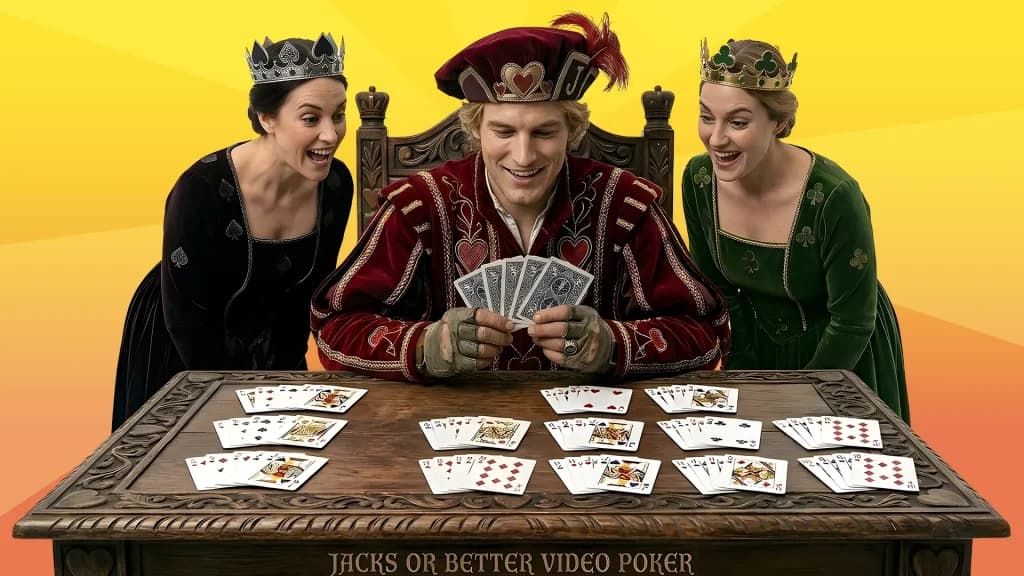
The good thing about Jacks or Better is that the strategy never changes. Whether we’re talking about 1 hand, 3 hands, or 10 hands, you’ll always follow the same guidelines you see above.
What, then, are the differences? The speed of the rounds, the pressure on your bankroll, and how aggressive the variance is.
1-Hand
With 1-hand Jacks or Better, you play one dealt hand at a time. It’s slower-paced and easily the best format for beginners who are learning strategy. You get time to think through your decisions before smashing the draw button like “Skip” on a YouTube ad.
3-Hand
3-hand Jacks or Better does the initial deal the same way. Each of the three hands receives five cards. Then, when you decide which ones to keep, those cards are held across all hands. When you draw, new, unique cards fill in the gaps across all three. That means one stronghold can pay three times over. Unfortunately, the opposite also applies. Still, it’s a nice middle ground if you want more winning opportunities without turning the session into pure chaos.
10-Hand
Now, give 3-hand Jacks or Better a cup of discontinued Panera’s Charged Lemonade, and it clanks, expands, and deploys into 10-hand Jacks or Better. This is when you call Optimus Prime and prepare for battle.
We’re speaking in hyperbole here. 10-hand Jacks or Better is not a feral Transformer doomed to eat your laptop; we simply wish to convey that there’s a lot going on.
It works just like 3-hand, except instead of drawing new cards to three hands, you now have ten to potentially land a win. Of course, that also means you’ll have ten hands to potentially lose. For that reason, 10-hand Jacks or Better has much higher bankroll swings.
| Feature | 1-Hand | 3-Hand | 10-Hand |
| Hands per round | 1 | 3 | 10 |
| Risk per round | Lower | Moderate | Higher |
| Bankroll burn rate | Slowest | Moderate | Fastest |
| Variance feel | Steady | Noticeably volatile | High swings |
| Best for | Learning the game / lower-stakes sessions | More action without overcommitting | Experienced players comfortable with variance |
One more thing. If you’re playing a multi-hand game, remember that it rapidly multiplies your coin commitment. A 10-hand game at $0.05 per coin costs $2.50 per round at max bet. Step that up to $0.25 coins, and now each round costs $12.50. Always be aware of what you’re betting before you hit ‘draw.’
3 Common Mistakes That Cost You Money
The biggest Jacks or Better mistakes usually happen before the draw even starts. Which is almost comforting, in a way. Nothing says “Hide the Pain Harold” quite like losing EV before your coffee cools down. But knowing the tips below will help you avoid being the next Hide the Pain meme.
Breaking Made Hands
The first mistake, which we mentioned in the optimal strategy, is breaking made hands to chase a Royal Flush. Yes, the Royal Flush payout is enormous. Yes, your brain immediately starts imagining a sick hot tub gazebo in your backyard.
But breaking a Full House or Flush to chase four cards to a Royal is a losing decision long term. The math simply does not support it.
The only exception is when you hold four cards to a Royal Flush. Then it’s worth going for it.
Jacks or Better video poker strategy works because you make the decisions that align with expected value over time. It doesn’t sound sexy, but you’ll be looking at your bankroll with dreamy eyes if you stick to the probabilities.
Playing Below Max Coins
The second mistake is playing below max coins. In Jacks or Better, the Royal Flush pays 800:1 at the full five-coin bet. Drop to four coins, and that same Royal Flush falls to 250:1. That is not a tiny downgrade. If your bankroll cannot comfortably handle the max bet at your current denomination, lower the coin value and keep the five-coin play.
Ignoring the Paytable
The third mistake is ignoring the pay table altogether. Playing on a weaker 6/5 or 8/5 machine when a full-pay 9/6 version is available increases the house edge before a single card gets drawn. You essentially just bought Hamburger Helper when the ribeye was the same price. Strategy matters, but the paytable sets the foundation.
Try Jacks or Better at Cafe Casino

At a certain point, the strategy chart can only do so much. The real learning happens once you start playing hands and seeing the decisions repeat in real time. That’s where the game slows down mentally, and your decisions become automatic. And what’s the best way to do this? Practice for free.
At Cafe Casino, you can play Jacks or Better for free when you open the game in Practice Play. Start with 1-Hand, then add a few to 3-Hands, and finally go buck wild with 10. Cafe Casino has all kinds.
To new players, we extend our warmest welcome, but you won’t receive a handshake—we’re cash people. On your first deposit, you’re entitled to a Welcome Bonus of up to $2,000.
With that bonus, you can also dabble in hundreds of slot games, table games, and specialty games, including other types of poker like Caribbean Stud and Pai Gow Poker.
Follow the tips in this guide to play Jacks or Better. With a little practice, you’ll find that you’re getting better, better, and better, until you meet Jack himself.
FAQ
What is the best strategy for Jacks or Better video poker?
The best video poker Jacks or Better strategy starts with playing at a higher-paying 9/6 table, where perfect strategy lowers the house edge to roughly 0.46%. Then look for the highest possible hand from your initial five cards. From there, always hold made hands, hold four cards to a Royal Flush over most other draws, and always play max coins for the boosted Royal payout.
What hands should I hold in Jacks or Better?
You should always hold paying made hands, including Straights, Flushes, Full Houses, and Four of a Kind. If you’re dealt a pair of Jacks or better, keep the pair and discard everything else. With Two Pair, hold both pairs and draw one card. Four cards to a Royal Flush outrank almost every other draw, while four to a Flush beats a low pair. Four to an outside Straight does not.
What’s the difference between 1-hand, 3-hand, and 10-hand Jacks or Better?
The strategy stays exactly the same across 1-hand, 3-hand, and 10-hand Jacks or Better. The difference is speed and bankroll volatility. In multi-hand formats, the same held cards apply across multiple simultaneous draws, creating larger swings in both directions.
Is Jacks or Better a good game for beginners?
Yes, Jacks or Better is one of the most beginner-friendly casino games once you learn the basic hold hierarchy. The pay table is fully visible before you play, so there’s less mystery than slots, and the rules are far easier to learn than traditional table poker. There’s still a strategy learning curve, but you get the hang of it surprisingly fast, especially since you face the same common decisions again and again.
Does playing max coins matter in Jacks or Better?
Yes, playing max coins matters enormously in Jacks or Better because of the Royal Flush payout. At lower bets, the Royal Flush usually pays 250-for-1. At the full five-coin bet, that payout catapults to 800-for-1, which dramatically improves the game’s long-term return. If your bankroll cannot comfortably support max bet at your current denomination, it’s usually smarter to lower the coin size instead.
More Poker Tips
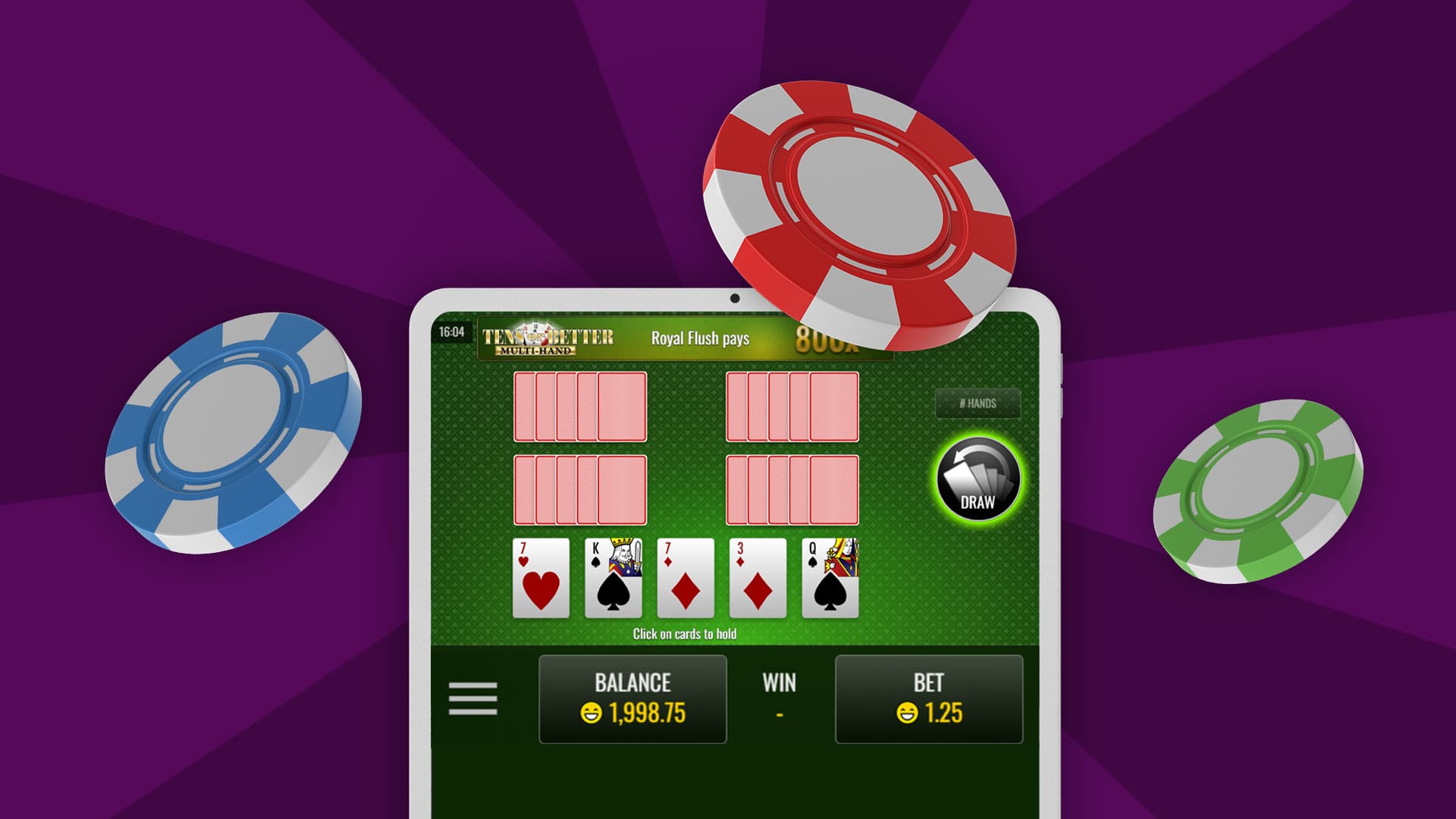
September 3, 2026
How to Play Video Poker: Poker at Your Own Pace
Video poker combines traditional poker strategy with the speed of slots. The payouts are awesome if you know what you’re doing – learn how to play here.
July 23, 2026
Best Video Poker Games for Your Style of Play
Video poker has multiple variants, each bringing a different flavor to the game. Learn the difference between them and find the right fit for your skill set.
September 3, 2026
How to Play Pai Gow Poker – A Step-by-Step Guide
Pai Gow poker is a low-volatility, poker-based card game with ample room for strategy. Learn how to play it and get strategy tips to easily win.
August 28, 2026
Blackjack vs Poker – Which Card Game is Right for You?
Learn which game suits your strategy, skill level, and playing style best and boost your winning potential today