Single Deck Blackjack vs Double Deck Blackjack – Which is better?
You sit down at a blackjack table and notice the placard: SINGLE DECK. That sounds good. Fewer cards, better odds – right? Maybe. But a quick look at the felt reveals something else: BLACKJACK PAYS 6 TO 5
Here’s the honest answer upfront: single deck blackjack usually carries the lower house edge, but only when it pays 3:2 with fair rules attached. Double deck tables often close that gap with friendlier conditions – and a well-run double deck game will beat a restricted single deck game every time. The payout and the rules matter more than the deck count alone.
This guide covers what sets each game apart, how the odds shift between them, and how to spot a good table before your chips go down.
What Is Single Deck Blackjack?
Single deck blackjack is played with one standard 52-card deck. Fewer cards in play means each card removed has a larger effect on the remaining composition – which is why the game has traditionally offered slightly better odds for the player compared to multi-deck shoe games.
In land-based casinos, single deck games are usually dealt by hand, with cards dealt face-down and the player picking them up to look. Online, the digital deck is reshuffled after every hand regardless, so the deck count has no effect on card composition from hand to hand.
The catch: casinos know single deck is mathematically friendlier to players, so single deck tables often come with compensating rule restrictions. Common ones include doubling down only on hard 9, 10 or 11 (instead of any two cards), no doubling after splitting, the dealer hitting soft 17 (H17), and – most significantly – blackjack paying 6:5 instead of 3:2.
Soft 17 is any hand totaling 17 that includes an Ace counted as 11, such as Ace-6. When the dealer hits soft 17 rather than standing, it marginally increases the house edge because the dealer has another chance to improve a hand that would otherwise stand.
What Is Double Deck Blackjack?
Double deck blackjack uses two standard 52-card decks shuffled together – 104 cards in total. It sits between single deck and the six- or eight-deck shoe games you’ll find at most casino tables, both in card composition effects and in how often rules tend to be favorable.
In land-based play, double deck games are typically dealt by hand like single deck. Online, as with any other game format, the deck is reset every hand.
What makes a good double deck table: 3:2 payout on naturals, doubling permitted on any two cards, doubling after splits allowed, and the dealer standing on soft 17. When those conditions are in place, double deck carries a house edge close to 0.3% under basic strategy – marginally higher than an equally well-ruled single deck game, but not by much.
Single Deck vs Double Deck Blackjack at a Glance
Here’s how the two games compare side by side, with a six-to-eight deck column as a reference point.
| Single Deck | Double Deck | Six to Eight Decks | |
| Cards in play | 52 | 104 | 312-416 |
| Typical blackjack payout | 3:2 (best) or 6:5 (worse) | 3:2 | 3:2 |
| Approx. house edge (3:2, basic strategy, S17) | ~0.15-0.2% | ~0.3% | ~0.4-0.6% |
| Common rule restrictions | May include 6:5 payout, restricted doubling, H17 | Generally fewer restrictions | Varies; rules usually published clearly |
| Chance of a natural blackjack | ~4.83% | ~4.78% | ~4.75% |
| How often the deck is shuffled | Frequently in land-based play; every hand online | Periodically in land-based play; every hand online | After cut card in land-based; every hand online |
| Basic strategy difficulty | A few more double-down spots | Very close to shoe strategy | Standard |
| Best for | Players finding a 3:2 game with good rules | Players wanting fair rules with low house edge | Most common; easiest to find with good rules |
House edge figures assume 3:2 payout, basic strategy, S17, doubling on any two cards, and doubling after splits. Actual edge varies by specific table rules. The most important takeaway from the table: a good-rules double deck game can easily beat a bad-rules single deck game.
Single Deck Blackjack Odds vs Double Deck Blackjack Odds
Fewer cards in play means each card dealt changes the remaining composition more. In a single deck game, dealing one Ace removes 1 of 4 Aces from the deck – 25% of all Aces in play. In an eight-deck game, it removes 1 of 32 – 3.1% of all Aces in play. That difference in deck sensitivity is why single deck has traditionally been seen as more player-friendly.
How the Number of Decks Changes the House Edge
Under identical rules, the house edge rises as deck count increases – but the jumps are smaller than most players expect. A single deck S17 game with 3:2 payout and standard doubling rules carries a house edge around 0.15-0.2%. A double deck game under the same rules sits around 0.3%. A six-deck shoe moves to around 0.4-0.6% depending on rules. The difference between one deck and two is real but modest.
Why the Payout and Rules Matter More Than the Deck Count
A 6:5 payout adds approximately 1.4 percentage points to the house edge. That single change takes a 0.2% single deck game to around 1.6% – significantly worse than a 3:2 double deck game at 0.3%. The dealer hitting soft 17 instead of standing adds around 0.2% more. Restricted doubling adds further.
The practical conclusion: a 3:2 double deck game with good rules beats a 6:5 single deck game. Deck count is the last thing to optimize for. Payout and rules come first.
Your Chance of Hitting a Natural Blackjack by Number of Decks
Natural blackjack probabilities by deck count, assuming no cards seen:
| Decks | Probability of a natural |
| 1 | ~4.83% (roughly 1 in 21 hands) |
| 2 | ~4.78% |
| 4 | ~4.76% |
| 8 | ~4.75% |
The differences are small. What makes the natural probability meaningful is the payout attached to it. When blackjack pays 3:2, a slightly higher natural frequency in single deck is a genuine benefit. When it pays 6:5, that small edge is wiped out many times over by the reduced payout on every natural that lands.
Why Casinos Added More Decks to Blackjack
Single deck blackjack dominated casino floors until the 1960s and 1970s, when card counting became widely understood. With fewer cards, a running count carried more weight and penetration – how far into a deck the casino would deal before reshuffling – was necessarily deep. Multi-deck shoe games diluted the counter’s advantage by making the deck less sensitive to each card dealt.
An additional benefit for casinos: however many more decks between shuffles means more hands dealt per hour, which increases revenue without increasing table count.
Online blackjack reshuffles the digital deck after every hand regardless of deck count, so counting has no practical effect on any online game. The choice between single and double deck online comes down purely to rules and payouts.
How the Number of Decks Changes Your Key Decisions
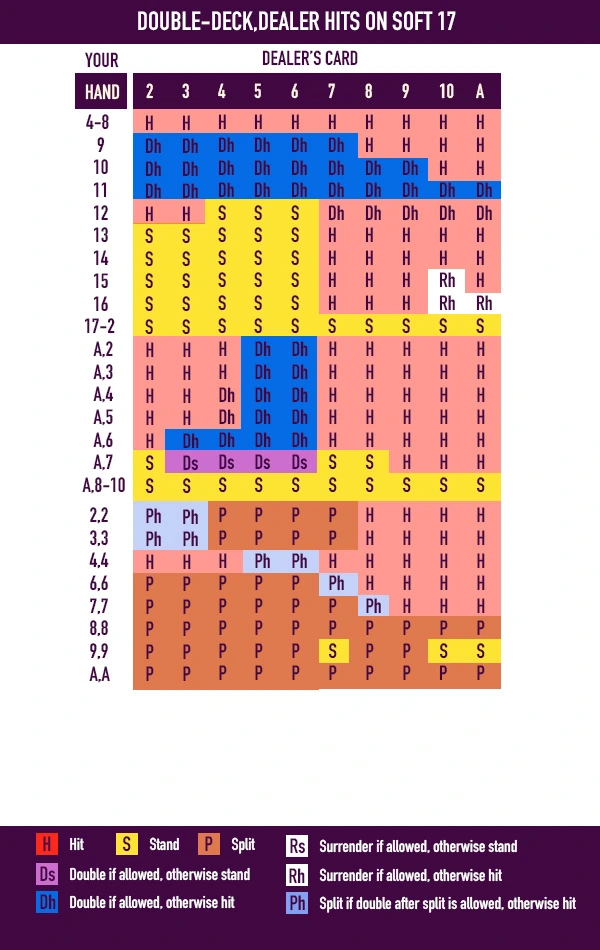
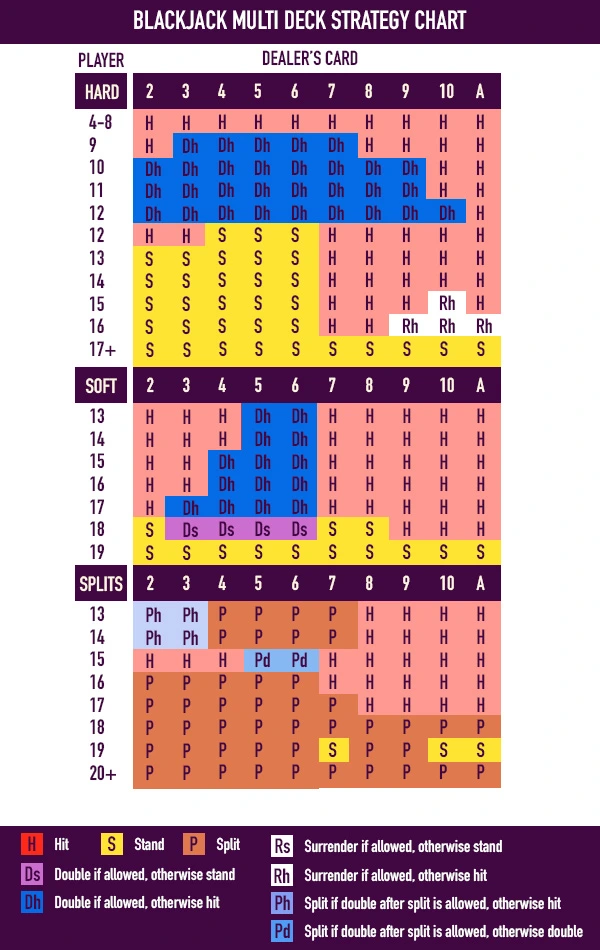
Basic strategy is nearly identical across one and two decks. A player who knows six-deck basic strategy already has the right answer for most single deck and double deck hands. A handful of borderline decisions shift slightly in single deck, mostly in the direction of doubling more aggressively.
This happens because with fewer decks, each card drawn affects the remaining composition more noticeably. When you’re doubling on 9 or splitting a pair, the odds of pulling a helpful card are very slightly different.
A few examples where single deck and double deck strategy can differ (under S17, DAS, full doubling rules):
| Hand vs dealer upcard | Single deck play | Double deck play |
| 8 vs 5 | Double | Hit |
| 8 vs 6 | Double | Hit |
| A,7 vs 2 | Stand | Double |
These are a small subset of the hands that differ. For the complete strategy for your exact game conditions, check a full basic strategy chart built for those specific rules and memorize basic strategy. Don’t rely on shoe strategy at a single deck table without verifying the differences.
Which Is Better: Single Deck or Double Deck Blackjack?
Single deck wins on paper – but only when the table pays 3:2 and doesn’t attach restrictive rules to offset the deck advantage. A 3:2 single deck game with standard doubling and an S17 dealer is the best-odds blackjack you’ll routinely find. That table is also rarer than it used to be.
When Single Deck Blackjack Is the Better Pick
- The table pays 3:2 on naturals – no 6:5.
- Doubling is permitted on any two cards, including after splits.
- The dealer stands on soft 17.
- You prefer the classic hand-held, face-down dealing style of a traditional one-deck game.
When Double Deck Blackjack Is the Better Pick
- The only available single deck table pays 6:5 – in which case a 3:2 double deck game is always the better seat.
- Single deck doubles and split rules are restricted in ways that partially offset the deck advantage.
- You want a low house edge without hunting for the rare good-rules single deck game.
How to Spot a Good Table Before You Play
- Check the payout. If it says 6:5, look elsewhere. Only sit down at a 3:2 table.
- Confirm the soft 17 rule. ‘Dealer stands on all 17s’ (S17) is better. ‘Dealer hits soft 17’ (H17) costs you around 0.2% extra.
- Check doubling rules. Full doubling on any two cards, including after splits, is the most favorable.
- Look for surrender. Late surrender (giving up half your stake on tough hands) is a rule in your favor where available.
- Compare available tables. If a 3:2 double deck sits next to a 6:5 single deck, the double deck is the better seat.
Set a session budget before sitting down and stick to it. A lower house edge means better value per session of entertainment – not a guaranteed profit. Play only with money you’re comfortable losing.
Find Your Favorite Table
Deck count is one variable in a multi-variable decision. The payout on a natural and the house rules around doubling and soft 17 matter more. A 3:2 double deck game with good rules is a better seat than a 6:5 single deck game regardless of the deck difference.
The best way to test the feel of each game without any stakes involved: try both in practice mode first. One deals face-down and plays fast, the other has a slightly different pace. See which one suits how you like to play.
Single Deck Cheat Sheet
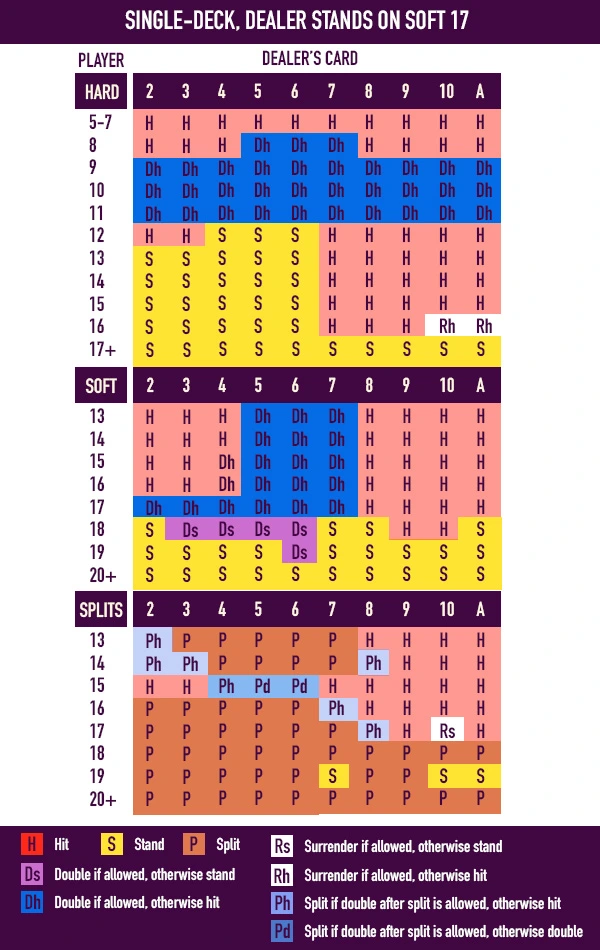
In a single-deck game compared to a double or multi-deck, you’re advised to stand on totals like 12 or 13 against a dealer’s 4 or 5 because the chances of a dealer bust are slightly higher with fewer remaining cards.
When faced with the same situation in multi-deck games, it’s wise to hit. That’s because, with more cards in play, there’s a greater likelihood that the dealer draws a strong hand, like 17 or higher. With multiple decks, it’s riskier to stand on weaker totals like 12 or 13.
Double Deck Cheat Sheet
Multi-deck Strategy Cheat Sheet
Single Deck vs Double Deck Blackjack FAQs
Is double deck blackjack better than six-deck blackjack?
Usually yes – under the same rules, double deck carries a lower house edge than a six- or eight-deck shoe. The gap is real but modest (around 0.1-0.2%). If the six-deck table has better rules or a more favorable payout, that can flip the comparison. Check rules and payout before deciding.
Why do some single deck blackjack tables pay 6:5?
Casinos use 6:5 to offset the player-friendly mathematics of a single deck game. A 3:2 single deck game with standard rules can carry a house edge below 0.2%. Adding 6:5 pushes it above 1.5%, which more than compensates the casino for dealing from a single deck. The extra payout loss on naturals costs a $10 bettor around $3 per natural – and naturals occur roughly four to five times every 100 hands.
Does the dealer hit soft 17 in single deck and double deck blackjack?
It varies by table. Whether the dealer stands or hits soft 17 is determined by the house rules at that specific table, not by the number of decks. Look for ‘Dealer stands on all 17s’ printed on the felt, or ask the dealer before buying in. Standing on soft 17 (S17) is more favorable for the player.
Can you count cards in online single deck blackjack?
No. Online RNG blackjack – including single deck versions – reshuffles the virtual deck after every hand. There’s no running composition to track between hands, so counting has no effect. Basic strategy is the right tool for online blackjack, regardless of deck count.
What is wonging in blackjack?
Wonging is the practice of watching a blackjack game without playing, waiting for the count to turn positive, and only buying in when conditions favor the player. Named after author Stanford Wong, it’s a land-based counting tactic with no application in online play where each hand starts from a freshly shuffled deck.
Can I practice single deck and double deck blackjack for free?
Yes. Cafe Casino offers free practice play on both games, which is the cleanest way to compare the pace and feel of each before playing with real money. Practice mode uses the same rules and payouts as the real-money game.
More Blackjack Guides
July 28, 2026
The 1-2-3-5 Blackjack Betting Strategy
The blackjack 1-2-3-5 betting system aims to capitalize on winning streaks and minimize losses – but does it really work? Discover tips to use it here.
April 10, 2026
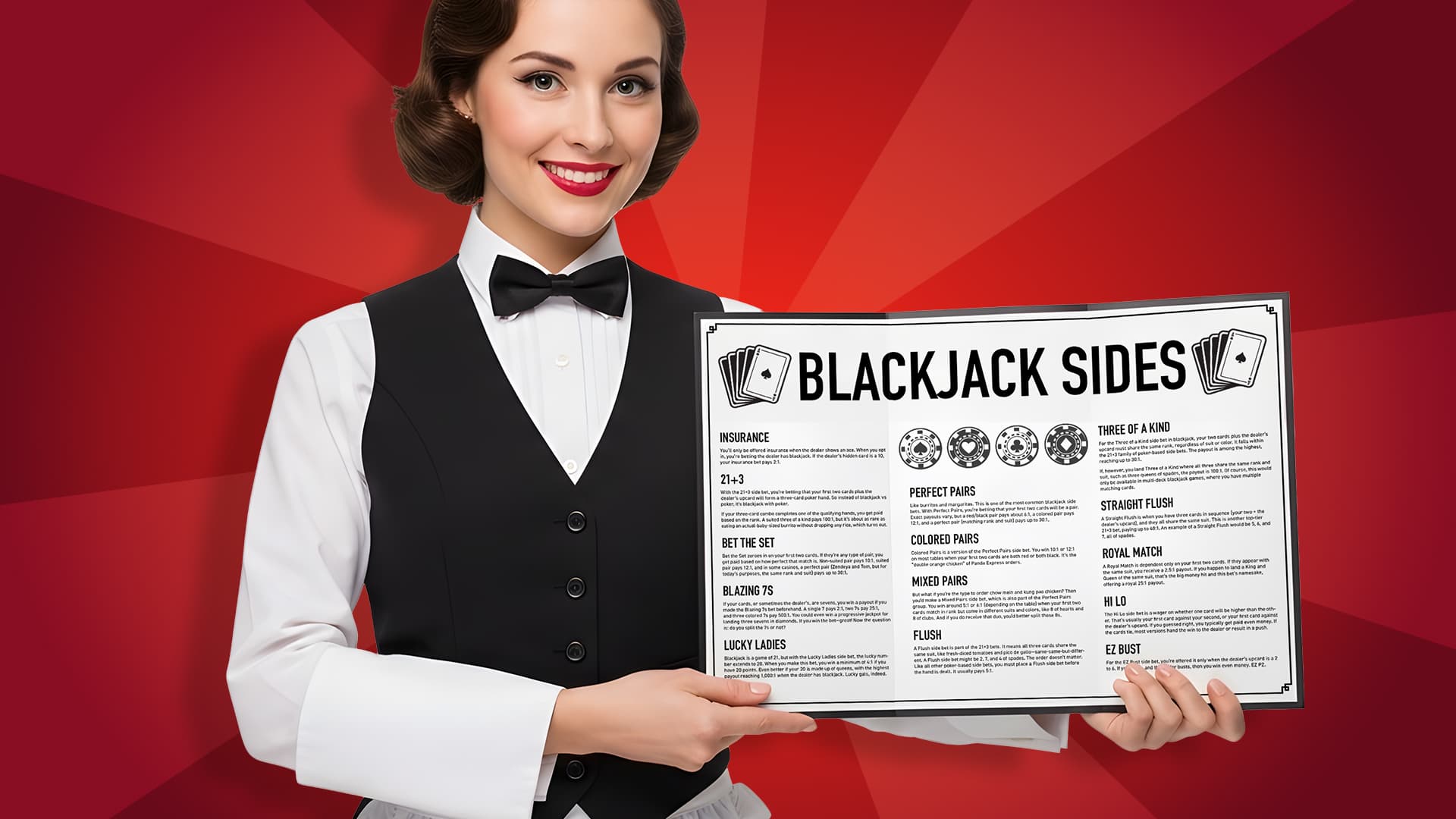
Blackjack Side Bet Sampler: Each One Explained
From 21+3 to EZ Bust, get the lowdown on all of the blackjack side bets, including which ones are worth your time. Pssst: One has a payout of 1000:1.
March 12, 2026
What is a Soft 17 in Blackjack? The Make or Break Hand
A soft 17 in blackjack isn’t your average soft hand. The rules behind it directly affect your house edge. Learn how it works & how to deal with it.

August 6, 2025
Your Playbook for a Soft 19 In Blackjack
A soft 19 in blackjack is already good, but it can be even better if you follow the proper strategy. Learn the right move for all types of blackjack.