
How to Memorize Blackjack Basic Strategy

You know that pause, dealer shows a 4, you’re sitting on a soft 18, and the right move is somewhere in the back of your head, just out of reach. Basic strategy has the answer for every hand, every dealer upcard, every time. The goal is to get those answers from “somewhere on that chart” to “automatically, without thinking.”
Playing accurately shrinks the house edge to around 0.5%, one of the best player positions at any table game. This guide gives you a clear path to getting there: the right strategy cards, the phrase method for building recall by group, flashcard drilling on the hands that trip players up, and a quiz to test yourself before you sit down. Download your free strategy card below and we’ll get to work.
Grab Your Free Basic Strategy Cards
Before anything else: grab the right card for the game you’re playing. Strategy varies slightly depending on the number of decks and one crucial rule, whether the dealer hits or stands on soft 17.
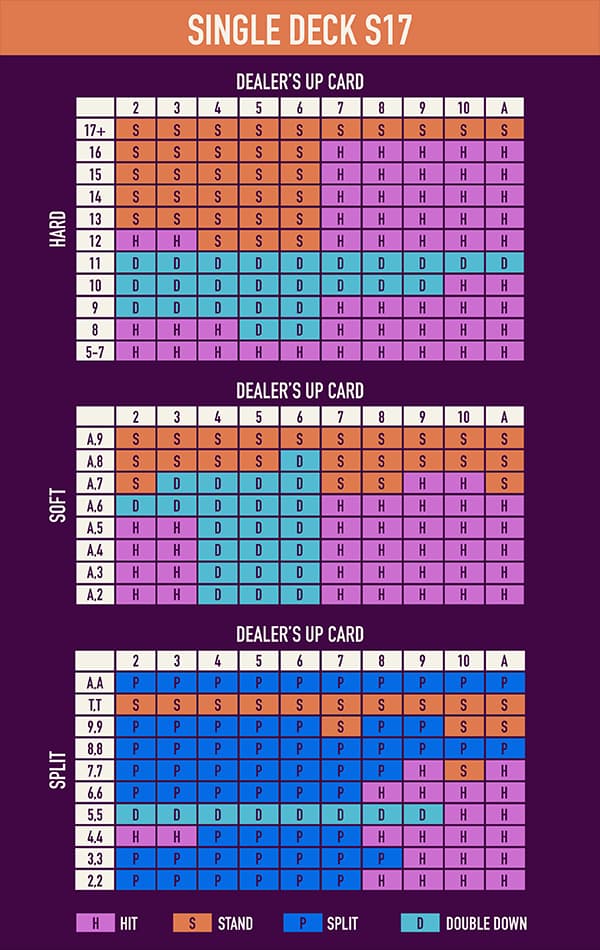
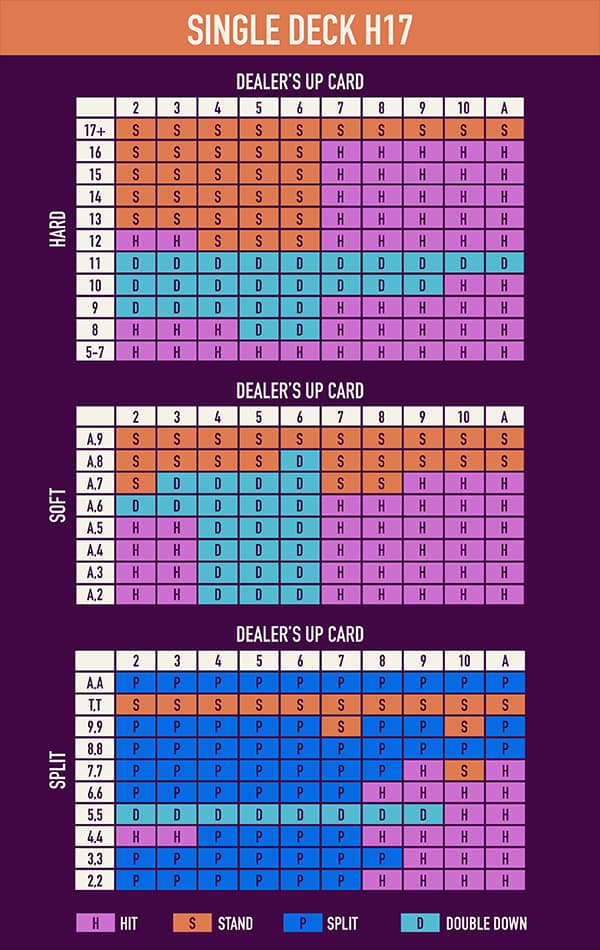
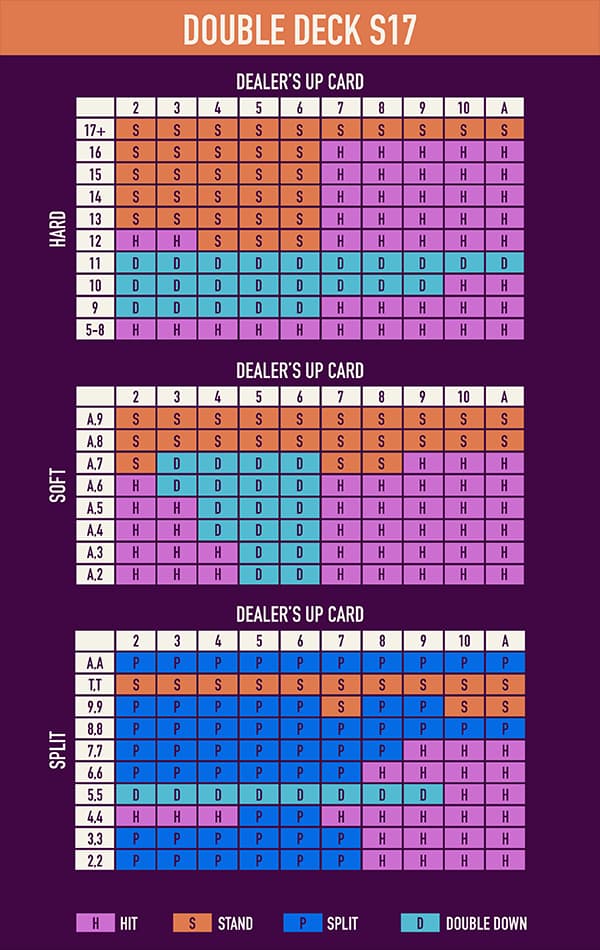
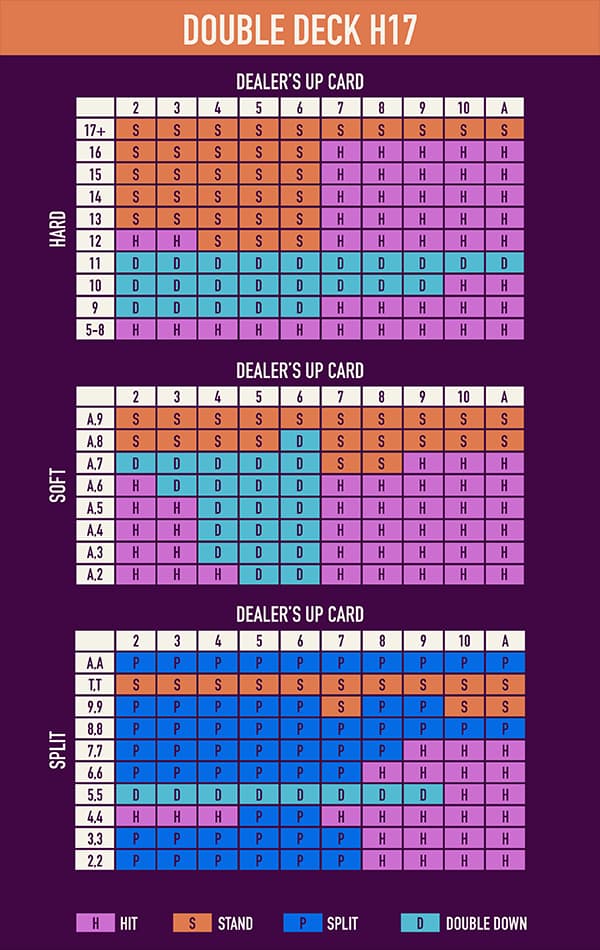
Single deck vs. double deck affects a handful of specific hands, particularly around doubling decisions. S17 (dealer stands on soft 17) and H17 (dealer hits on soft 17) change the optimal play on several hands where the dealer’s hidden card is relevant. For a full breakdown of single vs double deck and H17 vs S17 explained, see those dedicated guides. Once you know which version you’re playing, grab the matching card and keep it open while you practice.
Single Deck S17 Strategy Card
Single Deck H17 Strategy Card
Double Deck S17 Strategy Card
Double Deck H17 Strategy Card
The Phrase Method: Recite the Chart Like Sentences
The most effective way to internalize basic strategy isn’t staring at a chart, it’s turning the chart into things you can say out loud. Each row of the strategy grid becomes a short phrase. Say it enough times and the correct play becomes automatic.
Work through one group at a time, master each before moving on.
Splits
Splits are the smallest group and the best place to start.
- Always split Aces and 8s.
- Never split 5s or 10-value cards.
- Split 9s against 2 through 6, and against 8 or 9. Stand against 7, 10, and Ace.
- Split 7s against 2 through 7.
- Split 6s against 2 through 6.
- Split 4s against 5 and 6 only.
- Split 2s and 3s against 2 through 7.
Say each line aloud. “Always split Aces and 8s.” “Never split 5s or 10-value cards.” Say the whole group until it runs without hesitation.
Soft Hands
Soft hands, any hand with an Ace counting as 11, are the group that trips players up most consistently.
- Soft 20 (Ace-9): always stand.
- Soft 19 (Ace-8): stand, except double against 6.
- Soft 18 (Ace-7): double against 2 through 6, stand against 7 and 8, hit against 9, 10, and Ace.
- Soft 17 (Ace-6): double against 3 through 6, otherwise hit.
- Soft 16 (Ace-5): double against 4 through 6, otherwise hit.
- Soft 15 (Ace-4): double against 4 through 6, otherwise hit.
- Soft 14 (Ace-3): double against 5 and 6, otherwise hit.
- Soft 13 (Ace-2): double against 5 and 6, otherwise hit.
Hard Totals
Hard totals are where most players spend most of their hands, no Ace in play, just the total and the dealer’s upcard.
- Hard 17 and above: always stand.
- Hard 13 through 16: stand against dealer 2 through 6, hit against 7 through Ace.
- Hard 12: stand against dealer 4 through 6, hit against everything else.
- Hard 11: double against everything except an Ace, where you hit.
- Hard 10: double against 2 through 9, hit against 10 and Ace.
- Hard 9: double against 3 through 6, hit against everything else.
- Hard 8 and below: always hit.
Video walkthrough below if the recitation makes more sense with a visual guide:
Make Flashcards for the Hands That Trip You Up
You don’t need a flashcard for every hand on the chart, most of the decisions are easy once the phrase groups are down. What you need cards for are the border hands: the spots where the correct play flips depending on which dealer upcard is showing.
Soft 18 against different dealer cards is the classic example. Against 2 through 6: double. Against 7 and 8: stand. Against 9, 10, and Ace: hit. The same hand, three different correct plays. Use your downloaded strategy card to find the cells where the color changes, those are your border hands.
Write each card as the actual two-card combination, not just the total. “Ace-7” reads faster at the table than “soft 18.” On the back: the correct play for each relevant dealer upcard.
Drill with a timer. First pass: card and chart both visible, as slow as you need. Second pass: card visible, chart face down. Work toward answering each border hand in under three seconds without reference. Practice blackjack online in demo mode to reinforce the decisions in real time.
Test Yourself With a Quick Strategy Quiz
Before you sit down at a real-money table, test your recall on these hands. Cover the answers and see how you go.
| Your Hand | Dealer Upcard | Correct Play | Why |
| Ace-7 (soft 18) | 9 | Hit | Your expected 18 loses to the dealer’s likely strong total, hitting gives you a chance to improve |
| Pair of 8s | 10 | Split | 16 is one of the worst hands; two 8s give you two shots at an 18 instead |
| 11 | 6 | Double | You’re the favorite here, maximize the bet when the dealer is weak |
| Hard 12 | 4 | Stand | Dealer is likely to bust, don’t risk busting yourself |
| Pair of 5s | 8 | Hit (or double) | Never split 5s, treat 10 as a hard total and double against 8 if doubling is available |
If soft 18 surprised you, you’re not alone, it’s the most commonly misplayed hand in the game, and the reason is simple. Eighteen feels like a standing hand. Against a dealer 9, 10, or Ace, it isn’t. The chart is built on expected value over thousands of hands, and the math says hitting gives you a better long-run result than standing on soft 18 against those upcards.
More Ways to Make It Stick
- Learn in chunks, not all at once. Master splits, then move to soft hands, then hard totals. Each group has internal logic that makes it easier to retain once you’re not trying to hold the whole chart at once.
- Understand the reason, not just the rule. Knowing why you double 11 against a dealer 6 (they’re likely to bust, you’re likely to land in the high teens) makes the play feel logical rather than arbitrary, and logical decisions hold up under pressure.
- Short sessions beat long marathons. Ten minutes of active recall twice a day locks in more than a two-hour cram. Your brain consolidates during the gaps.
- Self-test constantly. Checking whether you know something is more effective than re-reading what you already know. Use the quiz above, use the flashcards, or quiz yourself while you play in free mode.
Put Your Strategy Into Play
The path is clear: download the right card for your game, recite the phrase groups by hand type, drill the border hands until they’re automatic, and self-test before every session until the chart feels like second nature.
Memorizing basic strategy won’t guarantee wins, the house edge is still there, even at 0.5%. What it does is put you in the best possible mathematical position on every single hand. That’s a real, meaningful advantage over playing by feel.
Practice in free demo mode first. Set a budget before you move to real money, and play within it. For free help if gambling becomes a problem, contact the National Problem Gambling Helpline at 1-800-522-4700 or ncpgambling.org.
FAQs
Is it hard to memorize blackjack basic strategy?
Not when you break it into chunks. The full chart looks intimidating as a grid, but split into three groups, splits, soft hands, and hard totals, each section has its own internal logic. Most players can get to reliable recall on all three within a few weeks of regular short practice sessions.
How to remember basic strategies for blackjack?
The most effective methods: recite each row of the chart as a short phrase and say it out loud until it’s automatic; make flashcards for border hands where the correct play changes by dealer upcard; self-test constantly rather than just re-reading. Repetition plus active recall gets there faster than passive review.
How long does it take to learn basic strategy?
A few weeks of consistent short practice gets most players to reliable recall on the key decisions. Full automaticity on every hand takes longer, but the hardest hands are a small group, focus on those and the rest comes quickly.
Do single deck and double deck blackjack use a different strategy?
Yes, in a few spots. Doubling decisions on some totals shift slightly between single and double deck. The differences are small but real. Download the card that matches your game, single deck or double deck, S17 or H17, and you’ll always have the right plays.
Can I keep a strategy card open while I play blackjack online?
Absolutely. Online blackjack doesn’t care if you have a chart up. Use it as a reference during early practice, checking the card on every uncertain hand is a faster learning tool than playing by instinct and wondering afterward whether you were right.
Why do you hit a soft 18 against a dealer’s 10?
Because a soft 18 isn’t as strong as it looks when the dealer is likely to have a high total. Against a dealer 10, the dealer often finishes with 18, 19, 20, or 21. Hitting soft 18 gives you a chance to improve the hand. Standing locks you in at 18 against a likely higher total. The math favors hitting.
Does memorizing basic strategy mean I’ll win at blackjack?
It means you’ll play every hand at the best possible mathematical position, around 0.5% house edge. But the house edge still exists, and any session can go either way. Basic strategy maximizes your long-run return and gives you more time at the table for the same bankroll. It doesn’t guarantee wins.
More Blackjack Strategies
December 3, 2025
Do You Split 9s In Blackjack?
A blackjack 18 is a great hand, but when it consists of two 9s, it can be even better. Learn when to split 9s and when to keep them together.
January 19, 2026
Do you split 8s in blackjack? SPOILER: Always
We’ll make this easy for you: yes, you should always split 8s. Still, it helps to understand why. Get the lowdown on why you should always split a pair of 8s.

February 9, 2026
Should you split 7s in blackjack?
It’s not one-size-fits-all, and treating every pair of 7s the same is a rookie move that’ll cost you
August 13, 2026
When to Double Down in Blackjack: The Hands Worth Twice Your Bet
Doubling down in blackjack means you double your original bet, take exactly one card, and stand. Learn when to use it to lower the house edge to rock bottom.