Blackjack Odds Explained: What Your Real Chances Are at the Table
Blackjack is one of the few casino games where your decisions genuinely make a difference. We’ll skip the preamble and present the blackjack odds upfront. You’ll:
- Win 42.4% of hands
- Lose 49.1%
- Push 8.5%
With correct basic strategy and favorable rules, the house edge hovers around 0.5%.
In the sections below, we’ll go into more detail. You’ll learn your chances of winning each hand, the player and dealer’s odds of busting, how different table rules affect the house edge, key payouts, steep-house-edge side bets, and more.
So, are you ready for some numbers? Don’t worry, we already did the dirty work. You just have to ride along as our Front-Seat Veep.
What Blackjack Odds Actually Mean
When talking about blackjack odds, three terms are tossed around interchangeably: odds, probability, and house edge. This isn’t like Wednesday Addams, Kramer, and Willy Wonka are different brands of weird. These three terms mean entirely different things.
Odds vs Probability
Odds express how likely an outcome is compared with how likely it is not to happen. For example, odds of 1:3, or 1 in 3, mean one favorable outcome for every three unfavorable outcomes.
Probability is the percentage chance that a specific outcome will happen; i.e., you have an 8.5% chance of your blackjack hand resulting in a push.
House Edge and RTP
The house edge is the built-in percentage that the house expects to win over the long run, such as blackjack’s 0.5% house edge with perfect strategy. The blackjack RTP is the other side of that figure: 99.5%. That’s what the player expects to win back over time.
Your Odds of Winning a Hand of Blackjack
Blackjack has three outcomes: the player wins, the dealer wins, or a push (tie).
Your official odds of winning blackjack are 42.43%. The dealer wins 49.09% of the time, and you have an 8.5% chance of a push.
Even less likely, but more celebratory, is winning a natural blackjack, which would happen roughly 4.75% of the time, or about 1 in every 21 hands. Suitable, isn’t it?
The dealer has an advantage because you start first. If you bust, you lose immediately, even if the dealer busts, too. That’s why the loss rate is higher than the win rate. You’re like Player 096 going first over the glass bridge in Squid Game. Being first doesn’t do you any favors.
The blackjack probability chart below gives you more context about your odds of winning blackjack.
| How often it happens | What is means for a session | |
| Player wins the hand | 42.43% | About 42 in every 100 hands |
| Dealer wins the hand | 49.09% | About 49 in every 100 hands |
| Hand pushes | 8.48% | About 8 or 9 in every 100hands/1 in 12 hands |
| Player is dealt a natural blackjack | 4.75% | About 4 or 5 in every 100 hands/1 in 21 hands |
| Player and dealer both dealt a natural | 0.22% | About 1 in 455 hands |
Your Odds of Busting by Hand Total
When you bust in blackjack, i.e., surpass a total of 21, you lose your hand outright, regardless of the dealer’s upcard.
You have 0% chances of busting on 11, but starting from 12, your risk begins at 30.8% and steadily increases. Once you reach 17 or higher, hitting would be a highway to Bustville. Don’t take another card.
Totals of 12 through 16 are the toughest spots to be in. You have to heavily weigh your bust risk against the dealer’s upcard. Continue to the chart in the next section to see the odds of the dealer busting.
The blackjack odds card below shows your chance of busting if you take one more card.
| Chance of busting if you hit | What the numbers suggest | |
| Hand total of 11 or lower | 0% | Impossible to bust with one more card |
| Hand total of 12 | 30.8% | Beware, but you’re likely okay |
| Hand total of 13 | 38.5% | Any face card plus a 9 could bust you |
| Hand total of 14 | 46.2% | Nearly half of all hits will bust, so it’s a toss-up |
| Hand total of 15 | 53.9% | More than half of your hits will bust now, so use extra caution |
| Hand total of 16 | 62.5% | Nearly 2 in 3 hits bust; pay close attention to the dealer’s upcard |
| Hand total of 17 | 69.2% | High risk of busting; only four cards won’t bust you |
| Hand total of 18 | 76.9% | Bust risk is very high |
| Hand total of 19 | 84.6% | Most hits bust |
| Hand total of 20 | 92.3% | Almost guaranteed; only the ace doesn’t bust |
How Often the Dealer Busts by Upcard
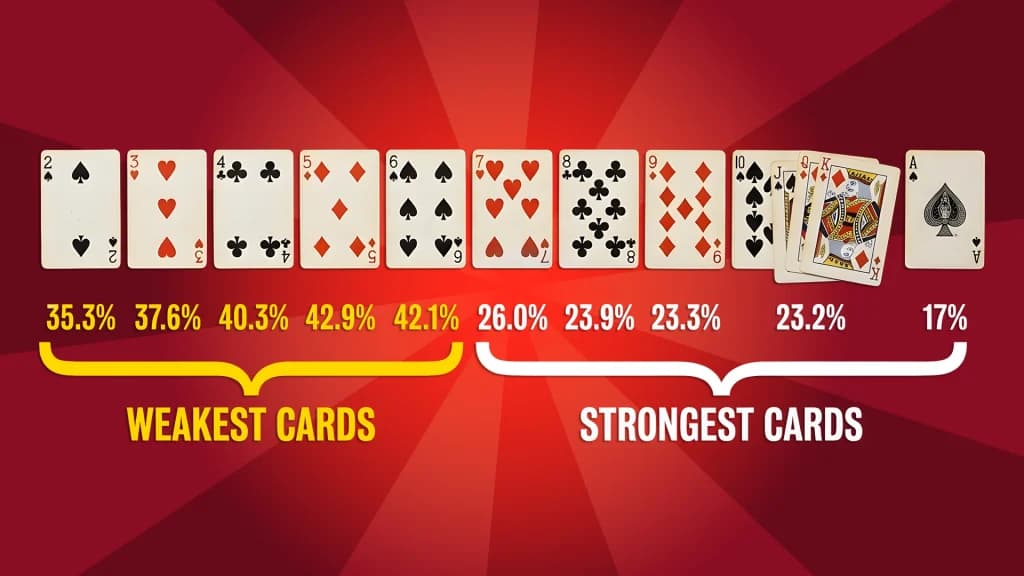
The dealer’s upcard gives you the best indication of how your hand might play out. A 2 through 6 is the dealer danger zone, while 7 through Ace gives them a strong starting position.
Their odds of busting peak with a 5 or 6, then drop sharply from 7 onward. If the dealer has a weak upcard (2 through 6), your best move is usually to stand when you have a lower total. Let the dealer take the risk instead.
The table below shows the odds of the dealer busting in more context.
| Chance the dealer busts | What is signals for your hand | |
| Dealer shows 2 | 35.3% | Weak upcard. Stand and let the dealer take the risk of drawing. |
| Dealer shows 3 | 37.6% | Weak upcard puts the dealer under pressure. |
| Dealer shows 4 | 40.3% | Very weak upcard. Hands 13-16 are okay to stand. |
| Dealer shows 5 | 42.9% | Stand most of the time unless on 4-11. |
| Dealer shows 6 | 42.1% | Stand on 12 or higher and let the dealer bust. |
| Dealer shows 7 | 26.0% | Decent card. Do not count on a bust. Hit and play aggressively. |
| Dealer shows 8 | 23.9% | Very strong card. Hit on all but 17+. |
| Dealer shows 9 | 23.3% | Dealer will likely not bust. Build your hand. |
| Dealer shows 10 or face card | 23.2% | One of the toughest spots for you. Surrender on 15 and 16. |
| Dealer shows an ace | 17.0% | The dealer is likely to hit blackjack. Either surrender or hit aggressively on 16 and under. |
How Table Rules Change the House Edge
Blackjack house edge isn’t a single number. It depends heavily on the table rules. The rules are always posted at land-based tables and described within the paytable in online blackjack.
Soft 17 Rules
Some blackjack rules state that the dealer must stand on a soft 17 (S17), while others require them to hit (H17). This H17 vs S17 rule affects the house edge. S17 is better for players and lowers the house edge because it doesn’t give the dealer more chances to improve. H17 would mean the dealer can hit and potentially improve their hand, and that’s not ideal.
Number of Decks
All else being equal, the number of decks in blackjack could be the deciding factor for a favorable house edge. That raises the next question: How many decks are used in blackjack, typically? The answer is anywhere from 1 to 8.
Single-deck blackjack is the winner with the lowest house edge, but having a shorter shoe does not automatically mean a better game. A single-deck game with H17 rules and a 6:5 blackjack payout won’t yield the house edge you’re hoping for.
Doubling and Splitting Rules
Doubling and splitting rules either increase or decrease the house edge.
Say you split a pair and end up with 11 on one of the new hands. If the table allows double after split (DAS), you can double your bet and take advantage of a strong total.
Or let’s say you split 8s and catch another 8. A table that allows re-splitting lets you turn one awkward pair into three separate hands instead of being stuck with two 16s.
Both are examples of doubling and splitting rules that are beneficial for the player.
Surrender
If surrender is allowed in blackjack, you can either early surrender or late surrender.
In both cases, you give up your hand and recover half of your original bet. Early surrender lets you do so before the dealer checks for blackjack, and late surrender means you can only give up your hand after the dealer checks for blackjack.
Early surrender lowers the house edge more because it can save half your bet even when the dealer turns out to have blackjack.
The table below shows how each rule changes the house edge, assuming all other conditions are the same.
| Shift in house edge | Better or worse foe the player | |
| Dealer stands on soft 17 | -0.22% vs. H17 | Better |
| Dealer hit on soft 17 | +0.22% vs. S17 | Worse |
| Blackjack pays 3:2 | -1.39% vs. 6:5 | Better |
| Blackjack pays 6:5 | +1.39% vs. 3:2 | Worse |
| Double down on 10-11 only | +0.18% | Worse |
| Double after split allowed | -0.14% | Better |
| Re-splitting aces allowed | -0.08% | Better |
| Late surrender offered | -0.08% | Better |
| Single deck vs six or eight decks | -0.56% to -0.59% | Better |
Blackjack Payouts: Why 3:2 and 6:5 Are Not the Same Game
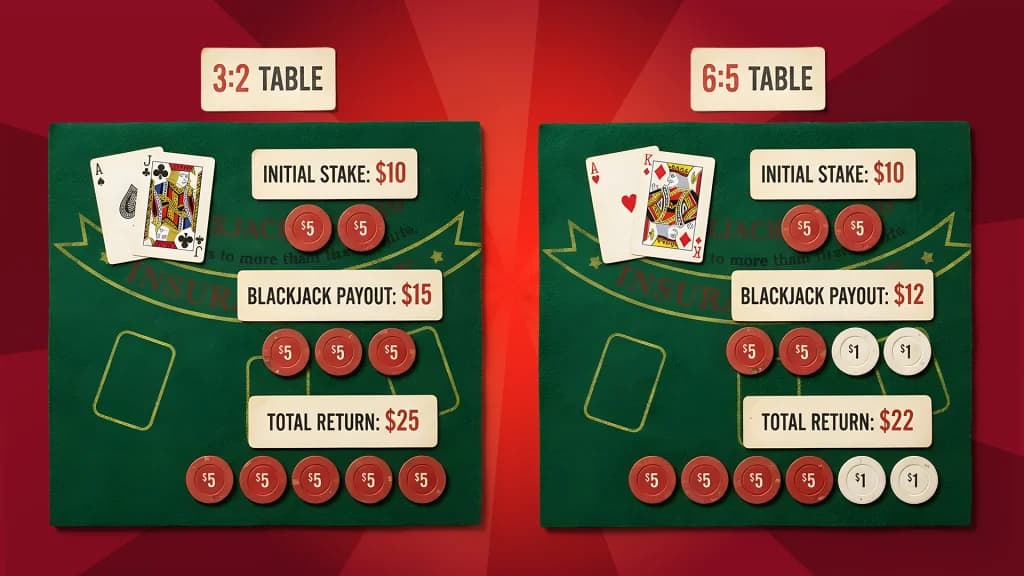
3:2, 6:5, who cares, right? Wrong. These are payout ratios, and choosing the wrong one costs you money. A 3:2 table pays more than a 6:5 table every time you’re dealt blackjack, although regular wins still pay 1:1.
The table below shows in dollars what the same stake returns under each payout. Changing from 3:2 to 6:5 adds about 1.39% to the house edge. Ouch.
At a physical table, the blackjack payout is printed directly on the felt or on a placard beside the table. In online blackjack, check the paytable or info panel.
| 3:2 table | 6:5 table | |
| Return on a $10 blackjack | $25 | $22 |
| Return on a $25 blackjack | $62.50 | $55 |
| Return on a $100 blackjack | $250 | $220 |
| Shift in house edge | Baseline | +1.39% |
| Worth seeking out | Yes | No |
Side Bets and Insurance Odds
Side bets are separate bets outside of the core blackjack game, and they require an extra wager. They have their own probabilities, payouts, and house edges.
While they can add a cheeky little thrill to the round, side bets have some of the worst blackjack statistics and don’t improve your odds of the main game.
Insurance and Even Money
Blackjack insurance pays 2:1 if the dealer has blackjack. The catch is that when the dealer shows an Ace, they only have blackjack about 31% of the time. It’s not worth the risk, so optimal strategy advises against it.
Even money is just insurance with a fake mustache. If you have a natural blackjack against a dealer ace, even money says you can accept a guaranteed 1:1 payout instead of risking a push. The problem is that, in doing so, you lose your chance at the 3:2 payout if you have blackjack and the dealer doesn’t
Perfect Pairs, 21+3 and Other Side Bets
Other blackjack side bets pay for specific card combinations, from matching pairs to poker-style three-card hands. Payouts like 25:1 and 100:1 or higher might make your wallet salivate, but the house edge on these bets is almost always steep.
That doesn’t mean avoid them entirely, but treat them as entertainment and nothing more.
| Headline payout | Approximate house edge | |
| Insurance | 2:1 | 7.5% |
| Even money | 1:1 | 7.5% |
| Perfect pairs | 25:1 | 4.1% |
| 21+3 | Up to 100:1 | 3.2% |
The Math Behind the Numbers: RTP, Expected Value and Variance
You can play at the most player-friendly table, cross every “t” and dot every “i,” and still finish a session at a loss. That’s because, even though you’ve maxed out the house edge, session variance is still a factor.
Expected Value
Blackjack expected value is your average result over many hands. With a 0.5% house edge, for example, $100 in total wagers carries an average expected loss of about 50 cents over the long run.
Variance
Variance in blackjack is why your actual session rarely matches that average. You might finish well ahead or well behind after 50 hands. The expected value is a calculation that applies over a long period of play; longer than your afternoon dalliance with the blackjack table, that’s for sure.
No number of wins or losses can change the odds of the next hand. The only way to mitigate losses is to practice solid blackjack bankroll management with clear stop-loss limits.
How to Give Yourself the Best Blackjack Odds
The biggest blackjack gift you can give yourself is to learn blackjack basic strategy. Well, you don’t have to learn it. You can literally just keep it next to you and look at it. But use it—that’s the point.
Below are the most important decisions you can make to play with the best blackjack odds.
- Use basic strategy. Can’t stress this enough. It lowers your house edge to 0.5%.
- Choose 3:2 tables. A 6:5 blackjack payout increases the house edge by roughly 1.39%.
- Play at S17 tables. S17 is more player-friendly and reduces the house edge.
- Decline insurance. Friends don’t let friends take insurance in blackjack. Its 2:1 payout does not make up for how often the dealer actually has blackjack.
- Avoid side bets. They have a much higher house edge.
Above all, set a budget before you play and stick to money you are comfortable losing. For support, contact the National Problem Gambling Helpline at 1-800-522-4700 or visit ncpgambling.org.
How Blackjack Odds Compare to Other Casino Games
Blackjack is the honor-roll kid of casino games. The overachiever. The one that comes prepared with a spreadsheet on movie night. Other games can’t hold a candle to blackjack’s house edge when played with perfect strategy. It’s also the only table game where your decisions make a difference.
The table below compares the house edges of the most popular table games plus slots, like the baccarat vs blackjack house edge, and more.
| Typical house edge | How much player decisions matter | |
| Blackjack with basic strategy | About 0.5% | High. Your hit, stand, double and split decisions directly affect the edge. |
| Baccarat, banker bet | 1.06% | Very little. Once you choose the banker bet, the drawing rules are automatic. |
| European roulette | 2.70% | None after the bet is placed. Bet selection changes volatility, not the standard house edge. |
| American roulette | 5.26% | None after the bet is placed. The extra 00 raises the house edge. |
| Slots | About 2%-15% | None. The game’s RTP and volatility are built in. |
Ready to Put the Odds to Work?
Blackjack’s math is knowable. We know because we…know it. And now you do, too. What you do with it is up to you.
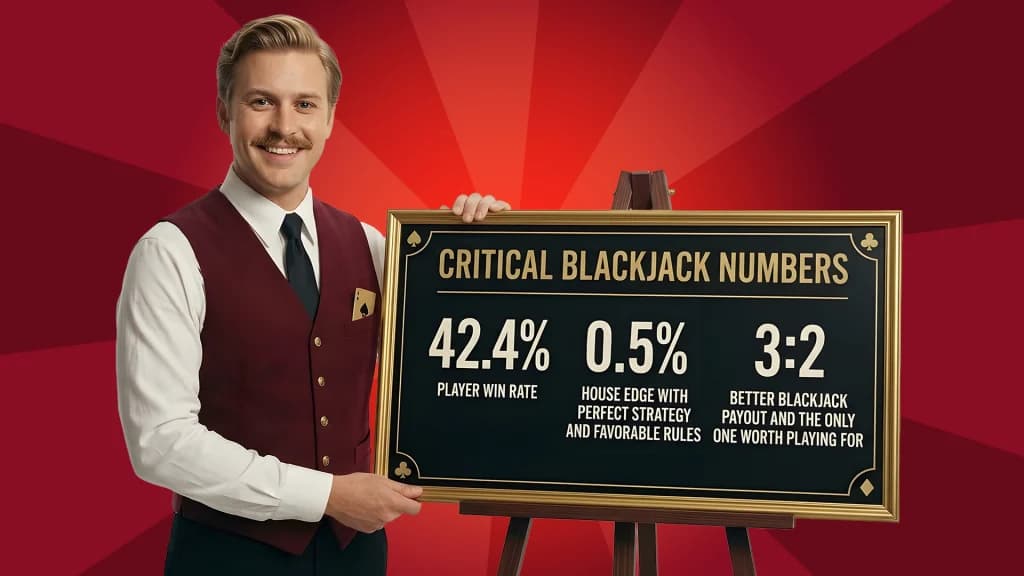
If there are three numbers you remember from this guide, make it these:
- 42.4%: The player win rate
- 0.5%: The house edge with perfect strategy and favorable rules
- 3:2: The better blackjack payout and the only one worth playing for
Try a few blackjack games online and see how the numbers appear in real hands.
FAQs
What are the odds of winning a hand of blackjack?
You’ll win about 42.4% of hands, lose 49.1%, and push 8.5% when playing correct basic strategy under favorable standard rules.
What are the odds of being dealt a blackjack?
Your chance of a natural blackjack is about 4.75%, or roughly 1 in 21 hands.
How often does the dealer bust?
The dealer busts about 28% of the time overall, with the rate climbing above 40% when showing a 5 or 6.
What are my chances of busting if I hit on 12?
You’ll bust about 31% of the time when hitting a hard 12. The dealer’s upcard determines whether taking that risk is the better play.
What is the house edge in blackjack?
With correct basic strategy and favorable rules, the blackjack house edge is around 0.5%. A 6:5 blackjack payout and a dealer who hits soft 17 increase it significantly.
Why am I losing when blackjack has such good odds?
Because the stated odds describe the long run, not one session. Variance means short-term results can swing well above or below the mathematical average.
Should I ever take insurance?
No. Insurance pays 2:1, but the dealer doesn’t hold blackjack often enough for that payout to make the bet worthwhile in normal play.
More Blackjack Guides
November 5, 2026
What Is DAS in Blackjack? Double After Split, Explained
What Is DAS in Blackjack? Double After Split, Explained What is DAS in blackjack? DAS stands for “Double After Split.” You’ll encounter this rule on an online blackjack paytable or rules placard if you’re playing in person. You’ll also see it factored into strategy charts, which is a key focus of this DAS guide. We’ll […]
November 3, 2026
Blackjack Guide: How to Play, What to Bet, and When to Make Your Move
Learn how to play blackjack, including the card values, the five key moves you can make, and a handful of special hands. It’s easy once you get the hang of it.
November 5, 2026
What Is an Ace in Blackjack? The Card That Plays Both Ways
An ace in blackjack counts as 1 or 11. It starts as 11 and automatically switches to 1 to protect you from busting. Learn how to play the ace correctly.
August 28, 2026
Blackjack vs Poker – Which Card Game is Right for You?
Learn which game suits your strategy, skill level, and playing style best and boost your winning potential today