Blackjack Terms: A Guide to the Language of the Table
- Blackjack actions: the moves you control
- Hands & outcomes
- Dealer calls & hand signals
- Rule codes & abbreviations
- Betting & bankroll terms
- Blackjack slang
- FAQs
Before you’ve settled into your seat at the blackjack table, you’re already hearing terms like double after split, resplit aces, and a shoe that is very clearly not going on anyone’s foot. Blackjack has its own vocabulary, and at first it can sound like the Glossary Hander Outer skipped you on the way in.
Luckily, there’s nothing too wacky hiding in the blackjack dictionary. Plus, just a handful of blackjack terms cover most hands, and you could get by on those alone.
Rather than tossing every term into one giant A-to-Z list, we’ve grouped our blackjack glossary by the situations in which you’d encounter them. If a situation ever arises, you can skip straight to the correct group to decipher the lingo.
Blackjack Actions: The Moves You Control
The terms below are the most important you’ll learn for blackjack. They’re the ones you’ll hear again and again as you play. They involve you making a decision during a hand (as opposed to a rule or slang).
Hit: Ask for another card. The dealer adds one card to your hand, and you can keep hitting until you stand or your total goes over 21 and you bust.
Stand: Keep the cards you already have and end your turn. You do not receive another card, and you wait for the dealer to finish their hand before you face off.
Double Down: Double your original wager and receive exactly one more card. Exact double rules vary by table, and some allow doubling only on certain totals.
Split: If two cards have the same value, like two 8s, you can place a second wager equal to your first and split them into two separate hands. The strategy around splitting pairs varies, so be sure to brush up on when to split in blackjack before you play.
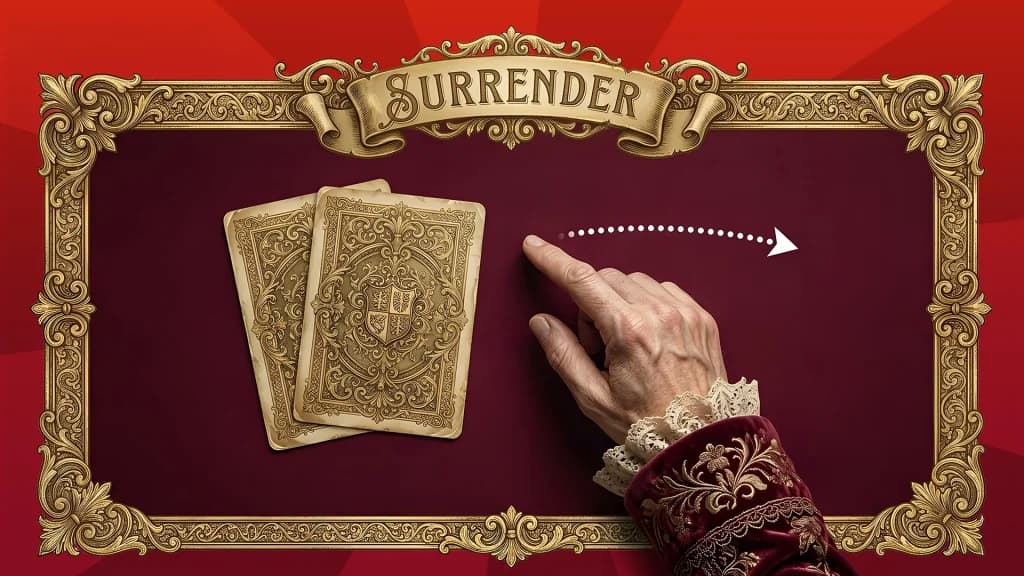
Surrender: Give up your hand before playing it out and receive half of your original wager back. There is both late and early surrender; not every blackjack table offers it in the first place.
Insurance: When the dealer shows an ace, you may be offered a separate wager that wins if the dealer’s hidden card completes a blackjack. Taking surrender is optional, and our guide on blackjack insurance explains in depth why it’s not a good idea.
Even money: If you already have blackjack while the dealer shows an ace, some tables let you take an immediate 1:1 payout instead of waiting to see whether the dealer also has blackjack. See our guide on blackjack even money to understand when you should take it.
Hands and Outcomes: What the Cards Add Up To
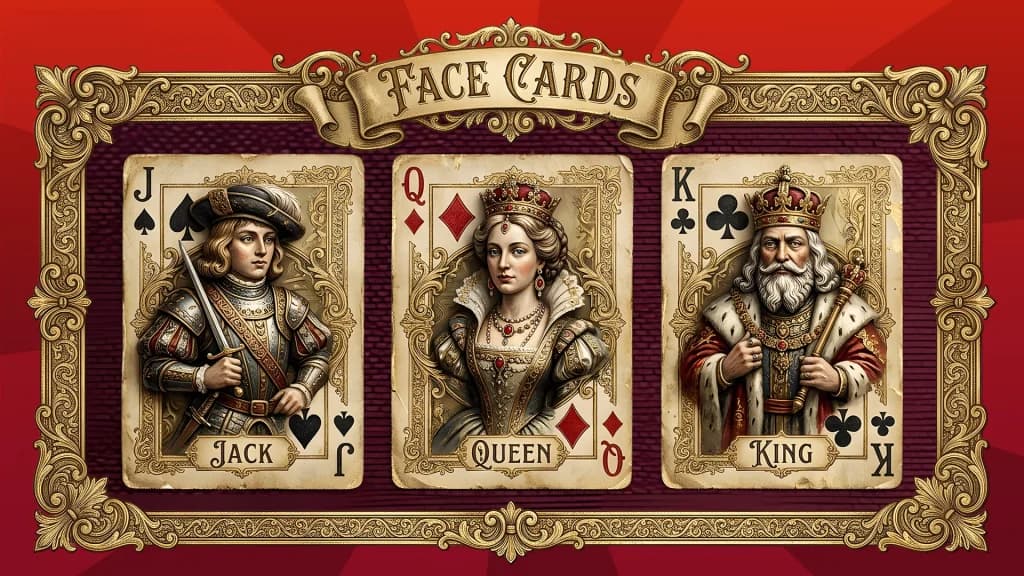
This section covers certain blackjack hands that have names based on their cards, their total, and how close they come to 21.
Blackjack or natural: When you have two cards that equal 21, made with an ace plus a 10, jack, queen, or king. Even though three cards can end up at 21, it’s only a “natural” if it was formed with two cards.
21: Any hand whose cards total exactly 21. You can reach it with two, three, or more cards, but only a two-card ace plus a 10-value card qualifies as a natural blackjack.
Ace: An ace refers to a regular ace in the card deck, but in blackjack, its value can be either 1 or 11, depending on whichever one helps the player more. Our guide to blackjack card values covers how every card contributes to your total.
Face cards: The jack, queen, and king. Each counts as 10.
Hard hand: A hand without an ace, meaning its total cannot be changed, or a hand with an ace that must count as 11 to avoid busting. For example, A + 6 + 10 becomes a hard 17 because the ace must count as 1 to avoid a total of 27.
Soft hand: A hand with an ace that can change its value based on convenience. An A + 6 starts as soft 17, with the ace as 11, but if you draw a 10, the ace drops to 1, and the hand remains 17 instead of busting. That flexibility is what makes a hand “soft.”
Soft 17: A 17 containing an ace counted as 11, such as A + 6. You’ll often see H17 or S17 in the table rules to show how the dealer must play this hand. We break that distinction down in our guide on soft 17 in blackjack.
Stiff hand: A hard total from 12 through 16. These hands are notoriously difficult to manage because another card can easily send you over 21, while standing may leave you with a weak total. Awkward little fellows.
Pat hand: A strong hand that totals 17 through 21. You don’t hit on a pat hand because it’s already a solid total. Might be accompanied by a few pats on the back, too.
Pair: Two initial cards of the same rank, such as two 8s or two queens. Pairs may qualify for a split, although the exact rules can differ by table.
Bust: When your hand goes over 21. The round ends for that hand immediately, and your wager loses, no matter what the dealer later does.
Push: A tie between your hand and the dealer’s hand. Nobody wins in the case of a push, and your original wager is returned.
At the Table: Dealer, Deck and Seat Names
Everything at the blackjack table, from the visible cards, the end seats, to the fellow or lady handing you said cards, has a name. This section covers the blackjack terminology related to the physical objects or people related to the game.
Some of these terms carry over to online blackjack, while others belong firmly in the land of felt.
Dealer: The person running the game. The dealer deals the cards, collects losing bets, and pays winners. Online blackjack has the same role, but the “dealer” is either software or a human live-streamed from a studio.
Upcard: The dealer’s face-up card, which everyone at the table can see. You use it alongside your own cards when deciding how to play your hand.
Hole card: The dealer’s face-down card. In online blackjack, there isn’t a literal card tucked underneath another one, but the concept works the same way: it’s a card you can’t see until it’s time.
Shoe: The holder that contains multiple shuffled decks and feeds cards to the dealer one at a time. A standard online RNG game doesn’t need a physical shoe, while live dealer blackjack does.
Cut card: A brightly colored plastic card inserted into the shoe during live blackjack to mark roughly where dealing will stop and a shuffle will take place.
Burn card: A card that the dealer removes from the top of the deck without being dealt to anyone. We’ve got the full story on what a burn card is in blackjack if you’re wondering why a perfectly innocent card just got banished. Hint: it’s a tradition.
Discard tray: The holder where the dealer places cards after each completed hand. You’ll see one at physical and live dealer tables; RNG blackjack simply clears used cards digitally.
Continuous shuffling machine: A machine that continually mixes played cards back into the available decks instead of waiting for the end of a shoe to reshuffle. It replaces the traditional shoe-and-shuffle cycle at tables that use one.
Box: The marked, card-shaped rectangle in front of a seat where you place your wager. You’ll find a digital equivalent in online blackjack, too. You drag your chips to the box to place a bet.
First base: The first seat to the left of the dealer, and the first to receive their cards.
Third base or anchor: The final player position before the dealer plays their own hand. The anchor has a slight advantage, solely because they can gather the most information by seeing what other players play first. These position names are only used at live tables; they’re irrelevant with standard online blackjack.
Pit boss: The Big Guy. The casino employee who supervises the tables and dealers on the casino floor. This is a brick-and-mortar job, so your regular online blackjack screen will not have a tiny digital pit boss hovering nearby. But if it did, he would definitely approve of your popcorn-M&Ms combo. That’s the stuff.
Heads up: When you’re the only one at the blackjack table and you play one-on-one against the dealer. The term also applies when you play live dealer tables and happen to be the only player seated.
Dealer Calls and Hand Signals
You communicate with the dealer at a live blackjack table through hand gestures, and they communicate with you through callouts. You should be clear on which hand gestures to use before you sit down. That way, you’re not disappointed when you feign punching your neighbor, and the dealer doesn’t take it as “hit.”
Below are the common blackjack calls a dealer will announce.
- Before a round starts, the dealer will announce, “Place your bets.”
- When the dealer’s upcard is an ace, they’ll say, “Insurance is open.”
- If you and the dealer end in a tie, you’ll hear, “Push,” and the dealer will return your original bet.
At a physical table, you signal important decisions with your hands so the casino cameras have a visible record of what you chose. Saying “hit” while your hand says “stand” is precisely the sort of plot twist everyone would rather avoid.
The table below shows what each hand gesture means at the blackjack table.
| Hand signal | What it tells the dealer | |
| Hit | Tap the felt beside your cards with one or two fingers. A scrape also works. | Deal me another card. |
| Stand | Wave your hand horizontally over your cards, palm down. | I’m keeping this hand as-is. No more cards. |
| Double down | Place an additional bet equal to your original beside it and point with one finger. | Double my wager and deal me exactly one more card. |
| Split | Place a matching bet beside your original wager and hold up two fingers in a V above the cards. | Split my matching cards into two separate hands. |
| Surrender | Draw a horizontal line across the felt with your finger, or simply say you want to surrender, which many dealers prefer. | End my hand now and return half of my original wager, assuming surrender is allowed. |
| Insurance | First, the dealer must offer insurance. Then, place half of your original wager on the marked insurance line above your cards. No additional hand signal is needed. | I’m taking the separate insurance bet against the dealer having blackjack. |
If you play live blackjack games online or simply regular RNG online blackjack, hand signals are replaced by on-screen buttons, so either way, the terms are the same, and you’ll want to know what the buttons mean.
Rule Codes and Abbreviations on the Felt
Blackjack tables rarely waste precious felt spelling out an entire sentence when three letters will do. That’s why you’ll see rule codes like DAS, H17, RSA, and LS posted around the table. That’s not the WiFi password. Each abbreviation tells you either what you’re allowed to do or what the dealer has to do.
| Stands for | What it changes for the player | |
| DAS | Double After Split | Af you split a pair, you can double down on either of those two new hands, giving you more opportunities to capitalize on a strong hand. |
| NDAS | No Double After Split | You cannot double down after splitting, so you have fewer options with those new hands. |
| RSA | Resplit Aces | If another ace appears after you split aces, you can split again, subject to the table’s split limit. |
| NRSA | No Resplitting Aces | Once you split your aces, another ace cannot be split again. |
| H17 | Dealer Hits Soft 17 | The dealer must take another card on a soft 17. This rule is generally less favorable to you than S17. |
| S17 | Dealer Stands on Soft 17 | The dealer stops on soft 17. This rule is generally more favorable to you than H17. |
| D9 | Double only on 9, 10, or 11 | You can only double down when your first two cards make a hard 9, 10, or 11. You cannot double on soft hands. This limits your double options. |
| DA2 | Double on Any Two Cards | You can double down on any initial two-card hand, giving you considerably more freedom than D9. |
| LS | Late Surrender | When the rule is offered, you can give up the hand and recover half your original bet after the dealer has checked for blackjack. |
While LS is the most common type of surrender, you might also see early surrender, which lets you surrender before the dealer checks for blackjack.
“No mid-shoe entry” is another one, which means anyone joining the table has to wait until the current shoe ends.
The H17 and S17 codes are especially common because they tell you how the dealer handles a soft 17, which is an important rule that affects your odds. In H17 vs S17 in blackjack, S17 always wins for player friendliness.
Money Talk: Betting and Bankroll Terms
When you’re not talking about your actions, the objects in the game, or the rules, all that’s left is money. The blackjack vocabulary below covers money-related terms used in the game.
Bankroll: The total amount of money you’ve set aside for blackjack. It’s separate from your everyday spending money, and good blackjack bankroll management starts with deciding that amount before you play.
Buy-in: The amount of money you decide to play with for that game, and you exchange it for chips when you join the table. Pay attention to the table minimum before you decide on your buy-in. If the table minimum is $25 per hand, a $40 buy-in won’t get you far. You’d be better off at a table with a lower minimum, such as $5.
Unit: A standard bet amount you use as a reference point. If one unit is $10, a two-unit wager is $20 and a five-unit wager is $50. Nice and orderly.
Table minimum and maximum: The smallest and largest bets you can make per hand. A $10 minimum and $500 maximum means your main wager has to stay within that range.
Flat betting: When you wager the same amount on each hand, rather than raising or lowering your bet from hand to hand. If you put down $10 every hand, you’re flat betting.
Bet spread: The range between your smallest and largest wagers. Betting anywhere from $10 to $50 gives you a 1-to-5 bet spread.
Side bet: An optional wager placed alongside your main blackjack bet, usually on a specific card combination or event. Side bets use their own rules and payouts, so treat them as separate wagers rather than part of the main hand.
Toke: Casino slang for a tip given to the dealer, done in chips. You may hand over the chip directly or, at some tables, place a small wager on the dealer’s behalf.
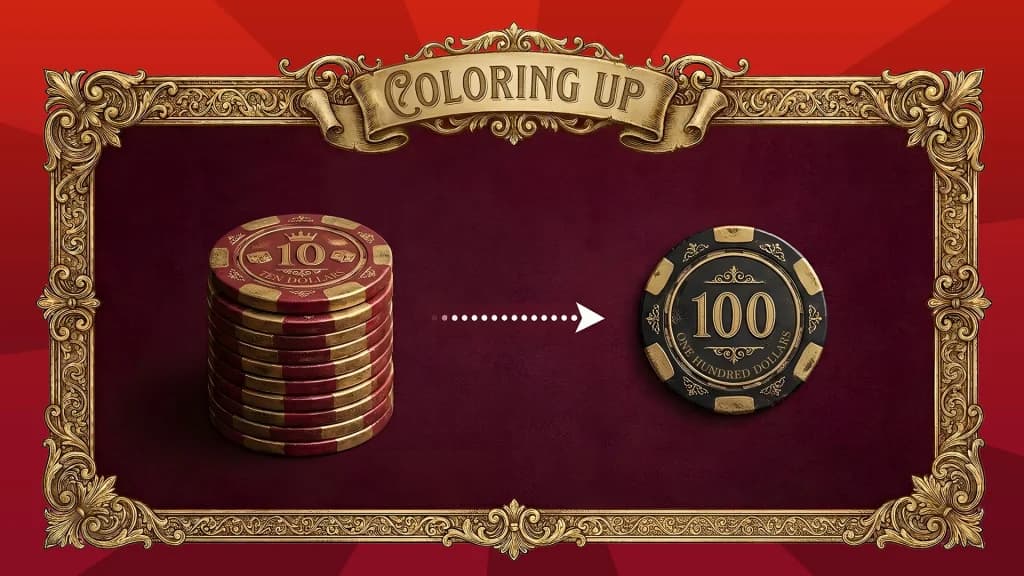
Coloring up: Exchanging a pile of lower-value chips for fewer higher-value chips, usually when you’re leaving the table. It’s like giving a store clerk ten $1 bills and asking for a ten.
Whatever terminology you use, the one word you want to use on repeat is responsible. Your blackjack bankroll should only be money you’re comfortable losing. Set your limits before you play, and stick to them. If gambling stops feeling manageable, the National Problem Gambling Helpline is available at 1-800-522-4700, with additional resources at ncpgambling.org.
Blackjack Slang You Will Actually Hear
Many blackjack terms are official, by-the-book vocabulary. Everyone says “stand” when they mean to keep their hand as-is.
But there are some terms that sound like they were invented at 2 a.m. by three Jay and Silent Bob-types sharing a plate of nachos. Introducing: blackjack slang.
You won’t find these terms in the rule book, but you’ll certainly find them being slung around the table from time to time.
Monkey: Blackjack lingo for a 10-value card, usually yelled when someone desperately wants one to appear. As in, “Monkey!” rather than the considerably less theatrical, “A face card would be nice, thank you.”
See: “What does monkey mean in blackjack?” for more on this particularly odd bit of casino vocabulary.
Paint: Any painted face card: a jack, queen, or king.
Ploppy: A not-exactly-flattering nickname for an inexperienced or casual blackjack player who plays by hunches, superstition, or whatever the moon seems to be suggesting that evening. Read: nincompoop. This is player slang, not something your dealer is going to announce across the table.
George: A good tipper. The term is commonly linked to George Washington’s face on the $1 bill, although your tipping ambitions need not stop at one Washington. (A George dealer didn’t pay us to say that, we swear.)
Whale: A high roller who wagers exceptionally large amounts of money and receives the sort of VIP attention that tends to follow exceptionally large amounts of money. Casinos and industry folks use this one too, although nobody is suggesting the person has fins.
High roller: A player who routinely makes large wagers. “High roller” is used as general casino terminology, not just for blackjack. Also see: Limp Bizkit with “We’re rollin’ rollin’ rollin’.”
Cold deck: Player slang for a deck or shoe that seems to be producing one disappointing hand after another.
Wonging: Used by card counters. It’s when they hop from table to table and only play when the count is in their favor. The name comes from blackjack author Stanford Wong, whose surname somehow ended up becoming a verb. Well, they’re not wong.
86’d: If you hear casino staff saying someone is “86’d”, it means they’ve been asked to leave and permanently banned from the casino. It’s also and most commonly used in restaurants and bars to indicate that a menu item is sold out.
Barred: Banned. This means you’re prohibited from playing blackjack, entering a casino, or both, depending on the circumstances. Just what did you do in there, troublemaker?
Now You Know the Language
You don’t need to sound like you were raised by feral dealers under a blackjack table to feel comfortable playing. Really—just knowing hit, stand, split, double down, blackjack, bust, push, and a few basic table rules is all you need to play the majority of hands in the game.
Once you’re familiar with the vocab, the table is much easier to follow. From there, the only sensible next step is to play blackjack games online and put your freshly polished blackjack vocabulary to work.
Now go forth, split wisely, and summon the monkey.
FAQs
What does DAS mean in blackjack?
DAS in blackjack stands for “double after split.” It means that after you split, you can double again on one or both of the new hands. DAS is favorable to the player since you can capitalize on the new hands.
What does RSA mean in blackjack?
RSA in blackjack stands for ReSplit Aces. If you split a pair of aces and receive another ace, an RSA table lets you split again. NRSA means no resplitting aces. Either way, this is a table rule, not a decision that you make in a regular game.
What is a shoe in blackjack?
A blackjack shoe is the device that holds and deals multiple decks of cards at a casino table. In online blackjack, software handles the cards instead, so there’s no shoe.
What is the difference between a hard hand and a soft hand?
A hard hand does not have an ace. For example, 10 + 7 is a hard 17. A soft hand contains an ace, which can count as either a 1 or 11, depending on convenience. A + 6 is a soft 17: it can be worth 17 or drop to 7 if another card would otherwise make you bust.
What does the dealer mean when they say insurance is open?
“Insurance is open” means the dealer is offering an insurance bet because their face-up card is an ace. You can wager on the dealer having blackjack with their hidden card. If you decline, nothing happens, and you continue the game as normal.
What is a natural in blackjack?
A natural, or blackjack, means your two cards equal 21 by having an ace and a ten-value card. You can still reach 21 with three or more cards, but that is not considered a “natural.”
Do I need to know all these terms to play blackjack online?
No. For most online blackjack games, knowing basics like hit, stand, split, double down, blackjack, bust, and push will carry you through most hands. Terms such as shoe, cut card, first base, third base, pit boss, and physical hand signals are more common in brick-and-mortar blackjack.
More Blackjack Tips
August 28, 2026
Baccarat vs Blackjack House Edge: Which Game Actually Gives You Better Odds?
A badly played blackjack hand can have worse odds than a well played game of baccarat. See how the odds change depending on your play.
August 13, 2026
When To Surrender In Blackjack
Blackjack surrender means you fold your starting hand and give up half of your original bet. Learn when optimal strategy says to use it and when to skip it.
August 4, 2026
Blackjack Bankroll Management: How to Set Limits, Size Your Bets, and Play Longer
Blackjack Bankroll Management: How to Set Limits, Size Your Bets, and Play Longer Pull up a chair. You’ve picked your table, you know your cards, and you’ve got one more thing to sort out before the first hand: a plan for your money. That’s blackjack bankroll management in a nutshell, not a high-roller system, not […]
July 17, 2026
Craps Terms You Need To Know – Craps Glossary
Confused about craps terms? This guide clears up all of the most common craps terms you’ll hear at the table, including come-out roll, lay bet, and buy bet.
June 29, 2026
Casino Terms Everyone Should Know
Casino Terms Everyone Should Know Author: Las Vegas Vlogger, @Sayhitomatthew, writes about their first-hand experiences with Las Vegas to give us valuable tips. Matthew is a self-proclaimed foodie who regularly reviews Las Vegas restaurants, buffets, and off-strip eateries as well as providing tours of the Las Vegas Strip, resort rooms, and updates on the newest […]