Single Deck Blackjack Strategy: Your Chart for the One-Deck Table
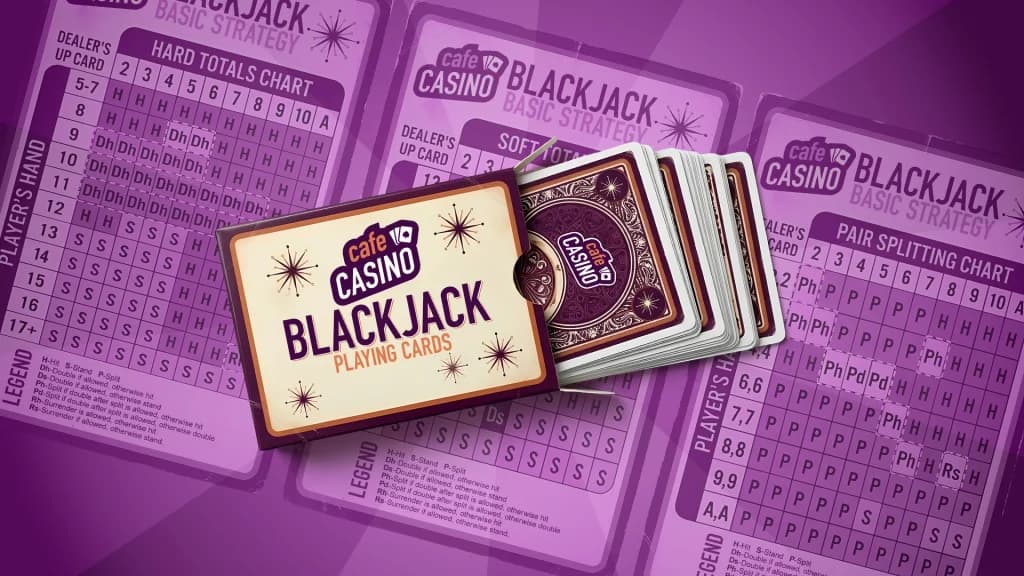
With just one deck in blackjack, hands are rapid-fire, and every card that leaves the shoe changes the odds.
Single-deck blackjack strategy is mostly the same as multi-deck, but the higher concentration of 10-value cards means a few key decisions are different from a multi-deck game. It also means the house edge is slightly lower.
In this single-deck strategy guide, you’ll get a full single-deck chart, an explanation of why certain moves change, the rules to check before you play, and a simple way to use the chart.
Table of Contents
- What makes single deck different
- Single deck blackjack basic strategy chart
- Single deck vs multi deck strategy
- Single deck rules that change
- How to use a single deck blackjack chart
- FAQs
What Makes Single Deck Blackjack Different?
One deck has 52 cards. Eight decks have 416 cards. Removing one card from a pool of 52 affects the remaining mix of cards far more than removing one card from a pool of 416.
It seems like it shouldn’t do much, but we all know the catastrophe that ensues after slightly adjusting an image in Microsoft Word. Sometimes, small adjustments have big consequences. That’s why it’s important to verify the number of decks used in your blackjack game.
Fewer decks are a benefit for you, the player. You receive more naturals overall and more opportunities to double, thanks to the higher concentration of 10-value cards.
That’s why, when the rules are fair, single-deck blackjack has the lowest possible house edge, even when you compare single-deck vs. double-deck blackjack.
While we do consider ourselves a fresh batch of smart cookies, we’re not the only casino to catch on to this player benefit. Casinos are well aware of the single-deck blackjack house edge, so the vast majority offset the advantage by tightening the rules, which we cover in this guide’s rules section.
Single Deck Blackjack Basic Strategy Chart
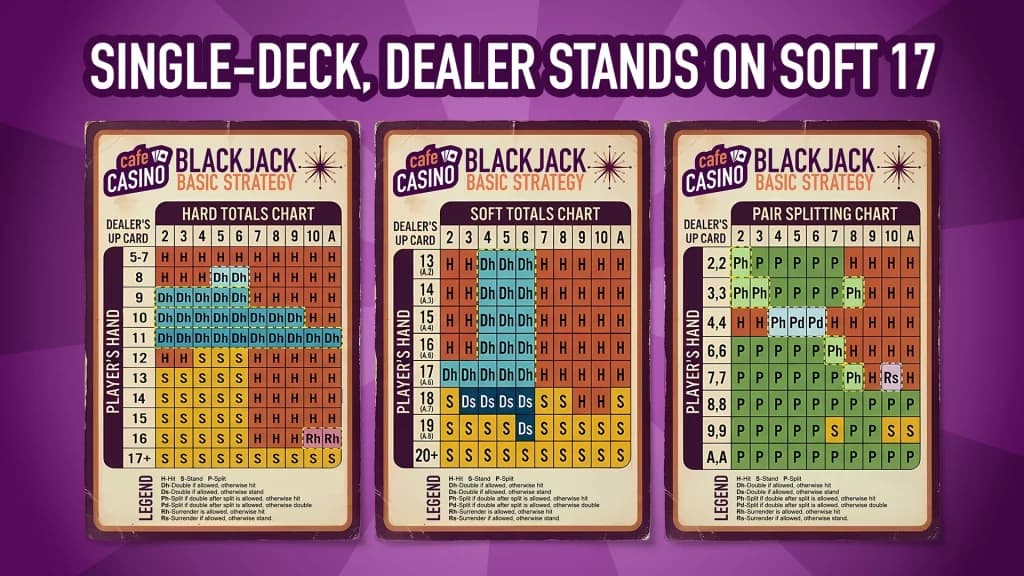
The single-deck blackjack chart below assumes the dealer stands on soft 17 (S17). It includes decisions for different table rules, such as doubling after a split or not (DAS/NDAS), restricted doubling, and surrender being allowed or not.
How to Read the Chart
The number in the left-hand column represents your hand. Find your hand total and follow the row until it meets the dealer’s upcard, which is the number in the top column. Do what it says in the cell.
Your options are:
H (hit), S (stand), Dh (double if allowed; otherwise hit), Ds (double if allowed; otherwise stand), P (split), Ph (split if double after split is allowed; otherwise hit), Pd (split if double after split is allowed; otherwise hit), Rh (surrender if allowed; otherwise hit), Rs (surrender if allowed; otherwise stand).
Hard Totals
A hard total is when your hand doesn’t have an ace, or the ace must count as 1.
Always stand on 13 through 16 if the dealer shows a weak upcard (2 through 6). The dealer has a higher chance of busting with these cards, so don’t push your luck by hitting.
Stand on 12 when the dealer shows 4, 5, or 6, but hit if the dealer shows 2 or 3. The dealer is slightly less likely to bust with these cards, so you should fight back with your weak 12.
The higher concentration of 10-value cards also makes doubling more favorable with hard 8, 9, 10, and 11 against a range of dealer upcards. You have a higher chance of reaching 18, 19, or 21, which are the strongest totals.
Soft Totals
Refer to the soft totals chart if your first two cards include an ace, or with any number of cards, if the ace can count as 11 without busting.
In a single-deck blackjack game, certain soft totals open up more opportunities to double, like Soft 13 and Soft 14 against a dealer’s 4. Another ten-value card can’t bust you, but it would make the dealer more likely to bust.
Pairs
If you have two cards of the same value, refer to the Pair Splitting chart.
We’ll make it easy: always split 8s and aces and never split 5s or 10-value cards.
For the rest, whether you split depends on whether doubling after splitting is allowed (DAS), with particular attention to 2s, 3s, and 4s, and one case each with 6s and 7s.
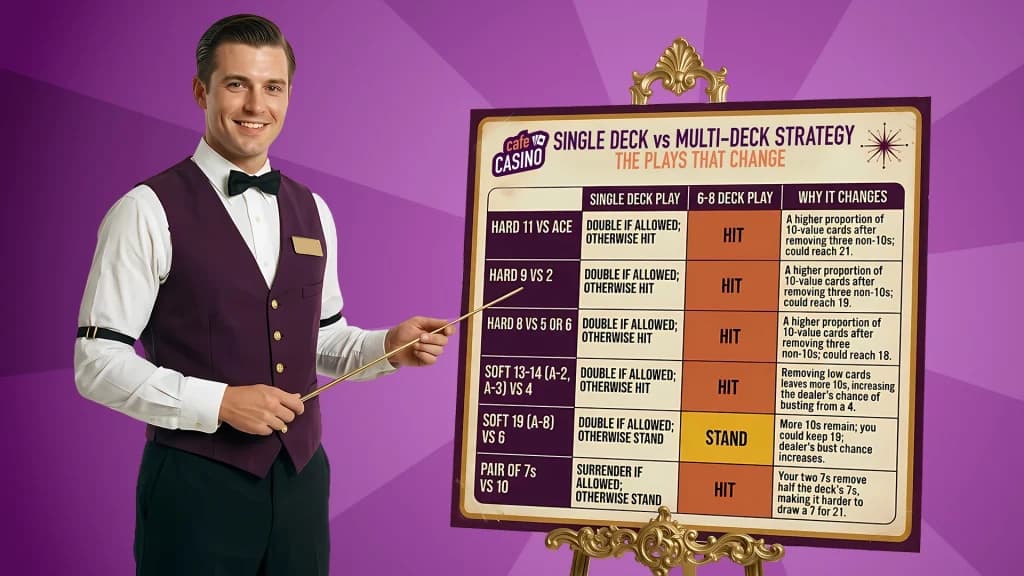
Single Deck vs Multi-Deck Strategy: The Plays That Change
If you’re already familiar with multi-deck strategy, nothing in single-deck blackjack strategy will throw you off too much. It really comes down to a few key doubling decisions and one surrender.
| Single-deck play | 6-8 deck play | Why it changes | |
| Hard 11 vs Ace | Double if allowed; otherwise hit | Hit | A higher proportion of 10-value cards after removing three non-10s; could reach 21 |
| Hard 9 vs 2 | Double if allowed; otherwise hit | Hit | A higher proportion of 10-value cards after removing three non-10s; could reach 19 |
| Hard 8 vs 5 or 6 | Double if allowed; otherwise hit | Hit | A higher proportion of 10-value cards after removing three non-10s; could reach 18 |
| Soft 13-14 (A-2, A-3) vs 4 | Double if allowed; otherwise hit | Hit | Removing low cards leaves more 10s, increasing the dealer’s chance of busting from a 4 |
| Soft 19 (A-8) vs 6 | Double if allowed; otherwise stand | Stand | More 10s remain; you could keep 19; dealer’s bust chance increases |
| Pair of 7s vs 10 | Surrender if allowed; otherwise stand | Hit | Your two 7s remove half the deck’s 7s, making it harder to draw a 7 for 21. |
What it comes down to is this: With only one deck, removing your two cards and the dealer’s upcard significantly alters the balance of the remaining cards in the deck. That’s especially true if those cards are low, because that leaves a higher concentration of 10-value cards in the ones that are left.
Most strategy decisions are based on either you or the dealer receiving a 10-value card. That could be a good thing, like bringing your total from 8 to 18, or it could be a bad thing, like making you more likely to bust. The correct decision adjusts accordingly.
The balance of the remaining cards and your current hand is all very salt-in-the-soup: The right amount earns compliments; too much earns a story your family tells Every. Thanks. Giving.
Single Deck Blackjack Rules That Change Your Chart
Before you play your first hand, take a second to double-check the table rules, because a few key decisions might differ.
Dealer Hits or Stands on Soft 17
One of the biggest changes is between H17 and S17 tables, meaning the dealer either hits on soft 17 or stands on soft 17.
You’ll surrender slightly more often with H17 since the dealer has another chance to improve their hand. That includes 15 and 17 against an Ace. If surrender isn’t available, hit the 15 and stand on the 17.
For soft hands, you’d stand on soft 18 against an Ace under S17 rules, but in the same matchup under H17 rules, you’d hit to fight back against the dealer potentially improving their soft 17.
Doubling and Splitting Restrictions
Doubling isn’t a one-size-fits-all, either. Some tables only let you double down on hard 10 or 11, so where the table calls for doubling on 8 or 9, you’d have to hit instead. Our chart indicates a backup plan, so you don’t have to remember the decision.
Other tables don’t let you double after splitting; this is known as NDAS. That would make certain splits less worthwhile. For example, skip the split on 2s and 3s against certain dealer upcards, and hit them instead. Again, refer to the chart for the exact decision.
3:2 vs 6:5 Payouts
Of all the single-deck blackjack rules, 6-to-5 blackjack tables are the most diabolical failure of human history—not to be dramatic or anything.
(Clears throat and smooths blazer) A 6:5 table pays you just $12 for a natural blackjack, whereas a 3:2 table pays you $15. It also raises the house edge by about 1.39%. That’s more than the house edge for a player bet in baccarat. It’s a sneaky little rule that you should avoid.
If you have to choose between the two, always prioritize the table with a 3:2 payout over the number of decks.
How to Use a Single Deck Blackjack Chart
Keep the chart open near your screen when you play blackjack games online, and follow these steps:
- Confirm the game’s rules before you start.
- Check whether the hand is a pair, a soft hand, or a hard total, and refer to the correct section of the chart.
- Find the dealer’s upcard.
- Do the action if it’s allowed. If not, follow the back-up decision.
The most important thing you can do to lower the house edge in online blackjack is to follow the chart. That’s all there is to it. Hunches are meaningless; the only way to play is to follow the math.
Our guide gives you tips on how to memorize basic strategy.
The best way to practice blackjack is to play in Practice Play (demo mode) for free before you risk real cash. You’ll start relying on the chart less and less the more you practice.
Above all, keep in mind that the chart reduces the house edge, but it does not eliminate it. Set a budget before playing. If gambling stops being fun, the National Problem Gambling Helpline offers anonymous support at 1-800-522-4700 and ncpgambling.org.
Pull Up a Chair at the One-Deck Table
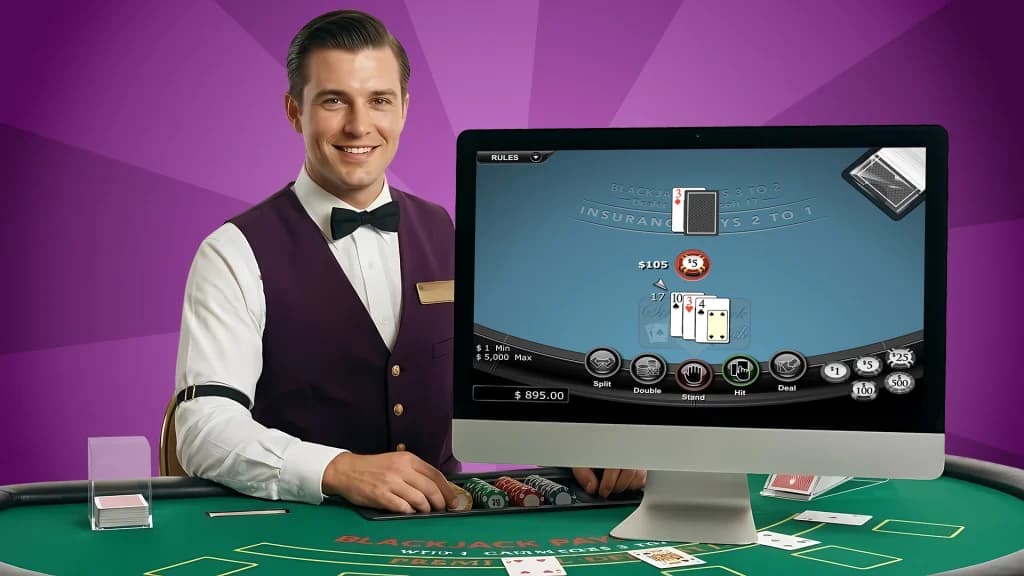
Let’s review.
The three most important points of single-deck blackjack strategy to remember are:
- Check the rules
- Follow the chart
- Be aware of the handful of plays that change with one deck
The rest is gravy.
When you’re ready for a one-deck dalliance, play single-deck blackjack online at Cafe Casino, and put your new skills to the test.
FAQs
Is single-deck blackjack better than multi-deck?
If you’re looking at the house edge alone and all other favorable rules apply, then yes, single-deck blackjack has the lowest house edge of all blackjack types. However, that can quickly be overridden by higher-house-edge rules, like a 6:5 payout, H17, and NDAS.
What is the house edge in single-deck blackjack?
Assuming it’s a table with a standard set of mostly favorable rules, the house edge can sink as low as 0.014% in single-deck blackjack.
Is single-deck basic strategy the same as regular basic strategy?
Mostly, yes, but a handful of doubling, splitting, and hitting decisions change. Refer to the comparison chart above.
Should you always double down on 11 in single-deck blackjack?
Yes. As long as the game allows it, double on 11 against every dealer’s upcard, including an ace. The same applies to both S17 and H17 rules. If doubling isn’t allowed, hit.
Can you count cards in online single-deck blackjack?
Not online, no. Digital RNG blackjack reshuffles after every hand. The count resets after each bet, so there’s no advantage to card counting.
Should you take insurance in single-deck blackjack?
No. It doesn’t matter how many decks are in play; insurance is always a low-value side bet that you should avoid. The 2:1 payout doesn’t compensate for how often the bet loses.
More Blackjack Guides

July 23, 2026
Dana White’s Blackjack Strategy: What the UFC Boss Really Does at the Table
Does Dana White have a secret blackjack strategy, or is it something else? We answer that question here, and what you can learn from how White plays blackjack.
July 30, 2026
What Is Insurance in Blackjack?
Blackjack insurance pays 2:1 but carries a 7.5% house edge. Learn how it works, when to take it, and why basic strategy says skip it.
October 16, 2025
What is a burn card in blackjack?
A burn card is when the dealer removes the top card of the shoe before dealing. Learn what a burn card is, why it’s useful, and if you’ll ever see it online.

March 23, 2026
What is even money in blackjack? A Bet You Should Skip
Is even money in blackjack a steal or a downgrade? Learn what to do when you have a natural and the dealer shows an ace. Spoiler: don’t take it. This is why.