
How Colin Jones and the Church Team Conquered Blackjack
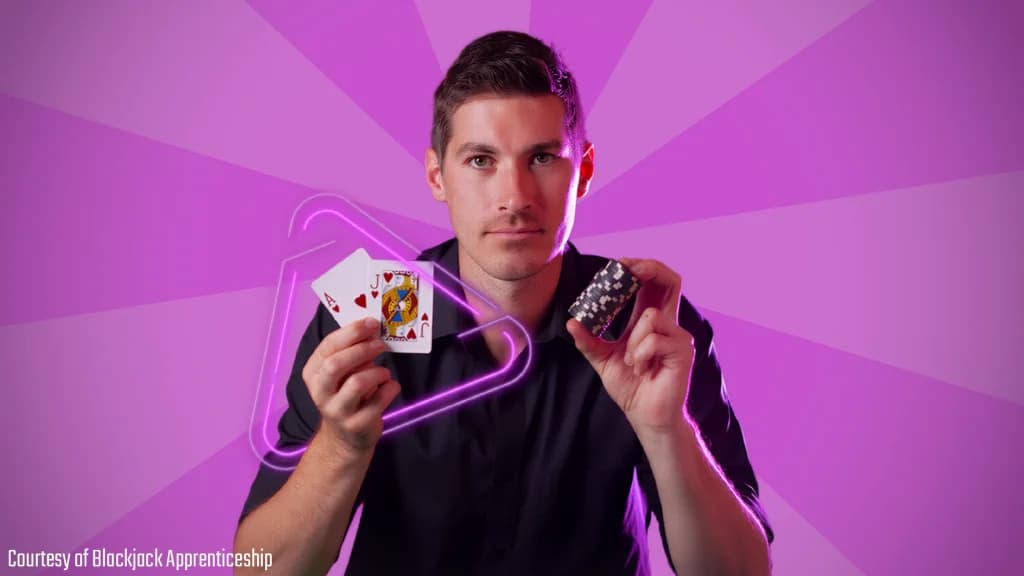
Michael Kaplan, a journalist who specializes in gambling, is the author of Advantage Players: Inside the Winning World of Casino Virtuosos, Master Strategists, and Mathematical Wizards. He sat down with Church Team co-founder Colin Jones to hear the story behind one of blackjack’s most unlikely and most successful teams.
Christianity and card counting may not seem like a natural pairing, but that did nothing to hamper the significant winnings of an advantage playing contingent known as the Church Team.
Co-founded by Colin Jones – who, through his Blackjack Apprenticeship online card-counting school and community, currently sends hundreds of skilled players onto casino floors – the team’s origins can be traced to a Christian summer camp based in the state of Washington.
Jones, 22 years old in the summer of 2002, had just graduated college as a math major. A professor of his supposedly card counted, though he kept that activity discreet and never came completely clean about it. Nevertheless, Jones was thinking about the gambit in July of that year while volunteering at Lakeside Bible Camp. One of his fellow counselors was Ben Crawford.
“Ben knew I was a math major, and he said, ‘Hey, check out this book,’” Jones told Cafe Casino. “It was ‘Professional Blackjack’ by Stanford Wong.”
TAKING A SHOT WITH THE MARITAL BANKROLL
Jones read the chapters that focused on card counting strategies, learned them and, one year later, freshly married with just $6,000 in the bank, started thinking about the advantage play as a money booster.
“I convinced my wife to let me take $2,000 and use it for a blackjack bankroll,” recalls Jones. “I began card counting and got stupid lucky. I doubled my bankroll in the first week. I called and texted Ben every day, letting him know how well it was going. Soon after, we decided to merge our blackjack money and form a two-person team.”
Sharing knowledge, providing support for one another and working out of a common bankroll, they were quickly on their way.

MAKING THE TEAM – AND NAMING IT
What started as a joke made by a friend – who found it odd for born-again Christians to be card counting – the group named itself the Church Team. Soon after, they went about recruiting and training additional players. There came to be 20 practitioners on the roster, all playing the Church Team way and putting in enough cumulative hours to iron out at least some of the variance that is baked into card counting.
In the midst of it all, Jones found himself wondering if his new profession jibed with his old-time religion. “I take my faith really seriously and I had to ask what would make card counting wrong,” explains Jones.
“It’s gambling, but I couldn’t find any Christian literature that had a reasonable explanation of gambling. There are proverbs that a fool and his money would soon be parted. But we were not fools. I realized that I could card count with integrity, play the game well and be competitive – just as people are in football or basketball. Jesus said his followers should be as shrewd as snakes and as innocent as doves. I think we adhered to that.”
RAISING THE STAKES
At the very start, with a tiny bankroll and a desire to not go broke, Jones bet units as small as $7, going up to maybe $70 per hand when the count went through the roof. But, as card counting worked its mathematical magic and the bankroll increased, Jones and his teammates ratcheted up their wagering.
“We graduated to $25 betting units, then $50 units before going to $100 and finally $500,” Jones recalls. “When the count got good, players would push out two spots of $2,000 for a total of $4,000 per hand. Ben, myself, and a few others bet up to $7,000, two spots of $3,500. But we wanted to keep our risks insanely low.”
The term “risk” refers not only to financial jeopardy but also to longevity at the table, to how much can be wagered (and hopefully won) before casino bosses got annoyed and backed them off from playing. “We had to limit our top bets to get in more action,” Jones admits. “It’s a matter of balancing what you can afford and what you can get away with. If you last five minutes before being asked to stop playing, you spend more on gas than you’re getting in expected value.”
As for the Church Team’s success, Jones remembers, “We eventually grew our bankroll to a million-dollars but we were always careful with our betting style and limits.”

CRAFTY COSTUME STRATEGY
Casino personnel are always on the lookout for counters. So, even with the reigned-in betting patterns, players on the Church Team took their share of backoffs.
But they had solutions for that. “Through a combination of wanting to throw off casinos and amuse ourselves, we got into wearing disguises,” Jones says. “If our BP [the big player, i.e., the person doing the large betting and being controlled by a counter] was burned, he might cut his hair and bleach it, then return to play. Of course, the problem with that is sticking out so much that the casino wonders, ‘Who is this guy?’”
More convincing, and more entertaining, get-ups were donned by the core players. “It was partly to throw off the casinos, but it was also about amusing ourselves,” says Jones.
“My favorite – and it’s not really PC – was something we called Cowboy and Indian. I dressed as a cowboy and Ben dressed as if he was from the country of India, complete with a turban. He was a known player, betting multiple spots of $500 and nobody recognized him. When they asked for his name, he just spelled out a bunch of consonants.”
Other outré looks? There was the time Jones dressed as a white gangsta and Crawford was an MIT nerd (pretty ballsy in light of the fact that the MIT card counting team had long ago raised the ire of casino executives) with a shirt that actually had the college’s logo on it. “He said his name was Ed Thorp,” remembers Jones, referencing the man who invented the card counting formulation. “This was before you needed ID to get a player’s card and Ben got one in the name of Ed Thorp. We all thought it was hilarious.”

BRINGING FAMILY VALUES TO THE CASINO
While they imbued their plays with fun – “Otherwise it feels like a job,” rationalizes Jones – members of the Church Team had serious lives away from the tables. “Our team was started by married family-guys,” says Jones. “So, we were not going on months-long trips or traveling to Korea for good games. We needed to stay close to home.”
Plus, due to their religious and cultural leanings, they were not out partying at night or doing the sorts of things that might hamper their skills the next day.
Through it all, though, the team founders knew that blackjack was not a lifetime pursuit. “We were always trying to start other businesses,” says Jones, explaining that the one which stuck for him was Blackjack Apprenticeship. Launched in 2008, initially as a partnership between himself, Crawford, and fellow team member Jon Collins, it was eventually taken over by Jones. He bought out his partners by 2016.
GROWING BLACKJACK APPRENTICESHIP
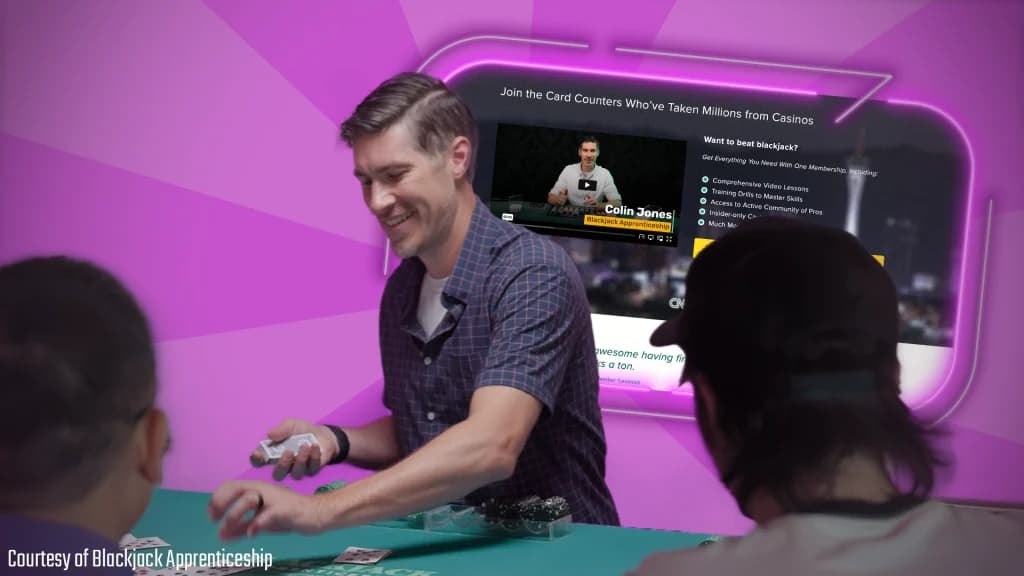
Blackjack Apprenticeship is part teaching-site and part community-site. After learning to card count, members share details on good games and tell inspiring stories about how they make the advantage-play life work for them. There are weekend-long seminars in which players can polish their skills to perfection and a curriculum that shows everything from game mechanics to bankroll management to moves that prevent casino executives from going on high alert.
Asked what it takes to make it as a card counter, once signing up with Blackjack Apprenticeship, Jones makes clear that commitment is where it begins. “The first requirement is that you need to train all the way through, learn everything that the program teaches,” he says, explaining that Blackjack Apprenticeship provides a step-by-step system, breaking down card counting into small segments that can become second nature over time. “Then you need to develop the soft skills, such as situational awareness, which will help prevent you from getting backed off and landing in a database of counters.”
While Jones’s hours at the tables are greatly reduced when compared to what they used to be, he still loves to occasionally buy in and test his skills. Such was the case on a recent family trip to Central America. “It’s really satisfying when you sit down and everything goes the way you want it to,” he says. “You’re using your brain, doing something that no one else at the table can do and hopefully you’re making a little bit of money. It’s like you’ve stepped into the Matrix.”
More from this author
July 15, 2026
John Chang: Mastering Blackjack the MIT Way
From disguises to drag to dorm rooms, John Chang and the MIT blackjack team rewrote the rules of the game. The Hall of Famer tells his story exclusively to Cafe Casino.
May 12, 2026
The Wild Ride of Blackjack Superstar Don Johnson
He walked out of Atlantic City casinos with millions. Blackjack legend Don Johnson tells us the story behind one of gambling’s most remarkable runs.

August 5, 2025
PLAY BACCARAT AND CALL UPON YOUR INNER JAMES BOND
Anyone who doubts the allure of baccarat needs to visit Macau. Enter a casino in the Asian gambling hub, situated some 33 nautical miles away from Hong Kong (you’ll likely travel there via ferry), and you instantly feel the game’s power.

December 15, 2025
7 SECRET CASINO ETIQUETTE TIPS
7 SECRET CASINO ETIQUETTE TIPS We all make etiquette mistakes – whether it’s dumping ketchup onto an exquisite cut of Wagyu beef, lighting up in a no-smoking zone, replying to All with an email message that was meant for only one recipient to see – but it’s particularly important to avoid committing gaffes when other people’s money […]

November 6, 2025
CELEBRITIES WHO LOVE TO ROLL THE DICE, SPIN THE WHEEL, AND BET ON THEIR FAVORITE TEAMS
Even for the most famous, most recognizable people on the planet, the thrill is undeniable when things go their way, and the chips (digital or physical) pile up.

November 27, 2025
The Wide World of Video Poker | Cafe Casino
The Wide World of Video Poker | Cafe Casino For people who love poker but like to leave their decks of cards in the drawer, video poker, in all of its many variations, is a perfect game. Plus, you get to play against the odds instead of taking on human opponents. That is, the game […]