
How Much Do Casino Dealers Make? A Look Behind the Table
- Short answer
- Base pay: the hourly wage on paper
- Dealer tips
- Does the game change the pay?
- What cities do dealers work in?
- What live dealers earn at online casinos
- How to become a casino dealer?
- FAQs
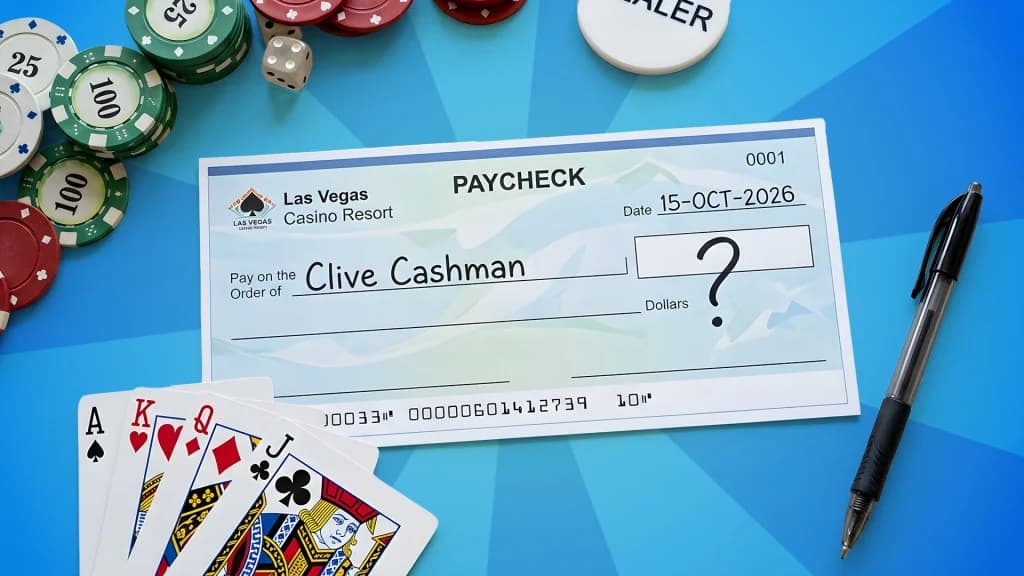
The dealer is everything. They’re part referee, part host, and they might even be part therapist for some. They deal cards, catch mistakes, and read the room, all with a cool and composed grin, and sometimes names like Clive.
Their important role begs the question: how much do casino dealers make for keeping all those plates spinning?
The hourly wage tells only part of the story. Tips matter far more.
Here, you’ll get the whole picture. We’ll reveal a casino dealer’s base pay and tips, compare dealer salaries between blackjack, poker, and craps, and size it up against what dealers earn in popular gambling places like Las Vegas and online at live casinos.
The Short Answer: What a Casino Dealer Earns
The Bureau of Labor Statistics (BLS) reports a national average of $20.46 per hour, or $42,550 per year, including tips, in its May 2025 data.
That’s how much dealers make at a casino on paper.
The thing is, a casino dealer’s salary is not an exact science. It depends heavily on the state, job, and shift, especially when tips are involved.
The salary before tips runs the gamut. Many job postings across states list the minimum wage, or close to it, as the starting salary. State minimum wage ranges from $7.25 in states like Tennessee, Pennsylvania, and Texas, to $16.94 in Connecticut and $17.13 in Washington.
As any server or bartender will attest to, the whole tipping thing means that each dealer’s success varies widely and is volatile from day to day, shift to shift, and job to job.
Base Pay: The Hourly Wage on Paper

Every casino dealer job has a base pay, which is the guaranteed hourly rate before tips are added.
Tips are such a big deal in a position like this that they can make up most of the take-home pay. The base rate is usually far lower than the bag the dealers actually take home.
The U.S. Bureau of Labor Statistics does not publish a national average base pay for dealers because its wage figures include reported tips. Its May 2025 data puts the mean wage for gambling dealers at $20.46 per hour.
As an average figure, this means that just a few rock-star dealer salaries, like basically any dealer from a James Bond casino scene, can boost the number.
The median is $16.50 per hour. From that perspective, it means that half of all casino dealers make less than that, including tips, and half make more.
Okay…so you can be Peter Parker earning a little, or Tony Stark earning a ton. How do we get ourselves on the Stark side of business? That depends on your schedule, not to mention your skill set for engineering arc reactors.
If you’re working full time as a casino dealer, you’ll log the most consistent hours, which obviously leads to more money. If you’re a part-timer, you’ll work fewer shifts and earn less overall.
As a newer dealer, you might start on what’s called the “extra board.” This is essentially an on-call scheduling pool that casinos use to cover absences and busier periods. In that case, scheduling, and thus your pay, is inconsistent.
But don’t worry; newbies won’t have to fetch coffee for Miranda Priestly types. You do have to look sharp, though.
Another point to keep in mind is that a standard shift does not usually mean eight uninterrupted hours rooted behind one blackjack table. Dealers rotate between games and take breaks. They’re sharp and snappy, but they’re not machines!
Tips: Where Most of the Money Actually Comes From
The base wage for casino dealers is merely the salad before the shrimp scampi, which might be an additional benefit of being a casino dealer: dining room discounts. But we digress.
Tips make up the largest part of your take-home pay. That’s why there’s really no such thing as a blackjack dealer salary. Tips adjust your earnings from month to month, whereas a salary is a fixed paycheck.
In casino speak, a tip is called a toke. No joke. Dealers can receive tokes directly from players or from bets on the dealer’s behalf.
What happens to those tokes next depends on the casino.
Pooled Tips
If the tips are pooled, casino dealers do not keep their own tips directly. Instead, all dealers combine their tokes and split the money, usually based on hours worked. You’ll love this system after a painfully quiet shift, because you can share in other dealers’ success. But if you had your own killer shift with particularly generous players…not so much. You’ll have to share.
Individual Tips
Another method is to keep the tips that you and only you made. Many players view this as the fairest, but if you have a rough day, there’s nothing to bail you out. A packed Saturday can feel glorious when you keep your own empire of tips, but a casual Monday…not so much.
How do you get more tokes?
If you’re wondering how much casino dealers make in tips, the answer depends on a laundry list of factors, but perhaps the main ones are the shift you work and your job’s location.
If it’s a busy day at a poppin’ and popular casino, more players means more opportunities to receive tokes. There are likely more high rollers during peak hours, too, with the occasional show-off tip to make your night. That’s right, Mr. Tip Heavy, keep ‘em comin’.
Generally speaking, if you keep the game moving and develop a good rapport—perhaps a “how’s the wife” or two—you have a better chance of a successful shift.
A word of wisdom from the chef in the kitchen: If you search for dealer accounts online, treat them as examples of what’s possible, not typical earnings. Property, shift, game, and tipping policy create too many variables for one dealer’s payday to represent everyone else’s.
Tips are income, and that includes casino chips and money received through a tip pool. Part of your job as a dealer is to track and report your own tips to your employer as well as on your own federal income tax return.
Does the Game Change the Pay? Blackjack, Poker, and Craps

While location is key, the game you deal also affects your earnings. Why? Because of tips. Everything is for the tips!
If it’s a fast-paced game, you’ll deal more hands, players will make more decisions, and there will be more opportunities for a happy player to flip a toke your way. That’s true for run-of-the-mill casino games, anyway, like blackjack, roulette, and craps. Poker is a little different.
Poker players don’t tip after their turn. It’s customary for winners to tip only after winning a pot.
Blackjack and craps dealers are more often than not tipped out through a pool, so their earnings are less dependent on one specific player or hand. So to answer the question of how much blackjack dealers make, the answer is, like all other casino games, it depends on the location and shift.
But you don’t get to waltz into a casino as a newbie and pick which games you deal for. Even if you already know how to deal blackjack at home and can prove it in a job audition, blackjack is still the standard game for new dealers.
Craps is reserved for those with more experience since there are more bets to track and a whole crew working the table. Poker comes with its own set of procedures that you’ll need to learn. If you ask how much poker players make, you’ll get the same answer: it depends on tips.
The table below shows how different casino games compare as a dealer.
| Blackjack | Poker | Craps | |
| Pace of play | Fast, frequent hands | Moderate, hand by hand | Fast, continuous action |
| How players tip | Chips or dealer bets after winning individual hands; often pooled | Commonly after a pot; dealer’s usually keep their own tips | Chips or dealer bets after a good win; often pooled |
| Player interaction | Constant table conversation | Dealer manages competing players | High-energy, boisterous table, managed by a team of employees |
| Skill and training required | Common entry-level game | More training required on procedures and pot management | Steepest learning curve |
| Physical demands of the shift | Mostly standing, with rotations | Seated | Standing, reaching and moving. Occasional high-fiving. |
| Typical earning pattern | Relatively consistent when pooled, but busier and slow shifts still have a big effect | Mostly tip-driven, resulting in more volatile earnings | Volatile, as earnings rise and fall based on how active the table is |
The bottom line is that the type of game isn’t a guarantee for the amount of money you’ll make as a dealer. The casino’s location and your shift are just as important.
Where They Work: Las Vegas, California, and Everywhere Else
Where you work is just as, if not more important, than which game you deal for.
A dealer in Las Vegas is likely making more money than a dealer in, say, Dull, Ohio (that’s a real place—look it up). But that’s not to throw shade on…Dullers? Dullites? Dullonians? In fact, the base hourly wage is practically the same; Nevada pays $12, and Ohio pays $11. It’s actually because of the traffic and tips.
The BLS May 2025 Occupational Employment and Wage Statistics (OEWS) data, which include reported tips, give us a useful snapshot for the three key gambling locations in the U.S.:
- Las Vegas Metro Area, NV: $17.51 per hour, or $36,420 per year, on average.
- California statewide: $19.78 per hour, or $41,140 per year, on average.
- Atlantic City-Hammonton, NJ: $21.04 per hour, or $43,760 per year, on average.
What’s more interesting is considering where these wages started and where tips landed them.
As we said earlier, there is no rule that casino dealers start at minimum wage. However, it’s quite common. So we’ll use that as a starting point.
The minimum wage in the Las Vegas metro area is $12 per hour. With tips, you earn $5.51 more per hour on average. Atlantic City has a similar jump, with a $5.12 increase, and the highest average earnings of the three.
California is in the middle, but the tips have only boosted the hourly rate by $2.88, since the state minimum wage is already $16.90.
So, even though Vegas technically started with the lowest minimum wage, tips boosted dealers’ earnings the most. Why? Because of traffic. More gamblers in the door mean more turnover and more potential tips.
So what about earnings in the U.S. overall?
The following are the top five earning states for casino dealers:
- Arizona: $70,590
- Washington: $69,630
- Florida: $53,150
- Oregon: $52,990
- Pennsylvania: $51,010
While the higher wages look promising, you have to consider the cost of living. For instance, your dollar stretches further in Pennsylvania than it might in Washington. If you leave work in Seattle and spend $30 on a bowl of ramen and a drink, you’re going to burn through your paycheck much more quickly overall.
Then there is the casino itself. A dealer working a Saturday night at a high-end resort or high-limit room has access to a very different stream of players than someone covering a quiet Tuesday afternoon at a smaller property.
Above all, remember that these figures are an average. Many dealers make much, much more…and many make less, too.
What Live Dealers at Online Casinos Earn

Picture the same blackjack table, the same shuffle and the same dealer calling “bets, please!”, only now the crowd has been replaced by cameras, studio lights and a chat window. That’s the world of live dealer games online, where dealers run real games from broadcasting studios.
When you deal games online, you need a slightly different skill set. Live casino dealers are, in many ways, entertainers, too. They chat up the players between rounds in one-sided conversations while simultaneously running the game. You’ll have to be comfortable on camera, that’s for sure.
There are multiple live dealer hubs throughout the U.S. and even the world, and they operate around the clock. Full-time and part-time shifts can cover afternoons, evenings, and overnights.
Tips are a different beast when you deal online. When you play live blackjack games online, you have to tap a button to leave a tip. It doesn’t have the same ease as smoothly sliding over a chip. For that reason, tips for online dealers might not be as plentiful. That’s why many live dealer employers include a guaranteed tip wage on top of your hourly base rate.
For example, you might make $17 an hour, but that consists of a $7 base rate plus a $10 guaranteed tip floor. Then, tips from players earn you more. The guaranteed wage package matters much, much more than when dealing in person.
So how much do online casino dealers make?
To give you a range, ZipRecruiter reports the average U.S. online casino dealer salary in August 2026 at $18.38 per hour, with most workers earning between $15.14 and $18.99 per hour. Of course, individual rates vary widely.
How to Become a Casino Dealer
You don’t need a college degree to become a casino dealer, and training usually takes weeks rather than years. BLS says dealers typically need a high school diploma or equivalent, followed by short-term training in a dealer school or directly through a casino.
Here’s how your dealer journey might look (similar to a hero’s journey, but with more shuffling and less sword wielding):
- Learn to deal one or more games. First, you need training. You can attend a private dealer school or find a casino that trains new hires in-house. A typical dealing school would take anywhere from two to six weeks, and could cost a few hundred bucks.
- Pass an audition. You can leave your Elphaba costume at home, but casinos will want to see how accurately you run the game and interact with actual humans.
- Complete the local licensing process. Casino employment is regulated at the state level, so the requirements depend on where you work. In most cases, you’ll have to submit to a criminal background check to get a license.
- Land your first table. As a new dealer, you’d likely start part-time or on call while building experience. You’d most likely start with blackjack.
Once you gain experience, you could potentially climb the ladder to dual dealer/supervisor positions, floor supervisor, pit or table-games manager, and eventually senior gaming management. At that point, you’ll no longer worry about tips as you’ll receive a set salary.
So, Is Dealing a Good Job?

If you like people, staying on your toes both physically and mentally, and like the idea of boosting your base wages through tips, even if it is more volatile than normal, then dealing could be a good job for you.
Casino dealers really can make good money. The tradeoff you’ll have to deal with is variability. Your income can rise and fall with the property, the shift, the game, and whether Brian the blackjack player got a good night’s sleep and is feeling generous. Also expect late nights and the occasional difficult player. Karens come to casinos, too.
Next time you sit down at a table, pay attention to the person keeping the game moving. A little awareness goes a long way, and a few casino etiquette tips can help you avoid becoming that player.
FAQs
How much do casino dealers make an hour?
Casino dealers in the U.S. earn an average of $20.46 per hour, according to the Bureau of Labor Statistics’ May 2025 data. That figure includes reported tips. Without tips, the hourly wage would be lower and highly dependent on the state and the casino’s minimum wage.
Do casino dealers keep all of their tips?
Not always. Some casinos allow each dealer to keep the tips they earn at their table. Others have a pooled tipping system, where tips from multiple dealers go into one pot and are divvied up based on the hours you worked, but casinos vary on their policy.
How much do casino dealers make in Las Vegas?
While there is no standard casino dealer salary, casino dealers in the Las Vegas metro area earned a mean of about $17.51 per hour, or $36,420 per year, according to BLS data from May 2025. That figure already includes tips. While this average is modest, working at a busy casino on the Strip, having a particularly lucrative shift, or sharing a larger tip pool could result in significantly higher wages.
Do blackjack dealers make more than poker dealers?
Poker dealers generally have more direct earning potential from tips than blackjack dealers. Poker players commonly tip the dealer after winning a pot, and poker rooms may let dealers keep their own tips. Meanwhile, blackjack tips are more commonly folded into a shared table-games pool, and there is no big pot, only regular hand wins.
What is the highest-paying job in a casino?
Out of all the careers you could have on the casino floor, being a general manager earns the most at an average of $103,050 per year, according to BLS data from May 2025. That far surpasses the average annual wages of dealers ($42,550), service workers ($41,880), and floor supervisors ($64,830). A casino general manager is salaried and does not receive tips.
Why do dealers tap the table when they leave?
The tap marks the dealer handoff. It’s usually accompanied by a little hand-showing or clapping routine as well. This is a sign to surveillance that the departing dealer is not carrying away chips or cards. They also do it when receiving tips to signal that the tip was given to them and they’re not just swiping players’ chips.
How much do live dealers at online casinos make?
The rate largely depends on the employer and state, but according to ZipRecruiter’s 2026 data for the U.S., the pay averages $18.38 per hour, with most workers earning between $15.14 and $18.99 per hour. Many live dealer jobs include a “guaranteed tip rate” within their hourly wage, plus additional tips.
More Casino Stories
September 3, 2026
How Colin Jones and the Church Team Conquered Blackjack
Born-again Christians, cowboy disguises, and a million-dollar bankroll. The story of the Church Team is unlike anything else in blackjack history.

May 12, 2026
The Wild Ride of Blackjack Superstar Don Johnson
He walked out of Atlantic City casinos with millions. Blackjack legend Don Johnson tells us the story behind one of gambling’s most remarkable runs.

July 15, 2026
John Chang: Mastering Blackjack the MIT Way
From disguises to drag to dorm rooms, John Chang and the MIT blackjack team rewrote the rules of the game. The Hall of Famer tells his story exclusively to Cafe Casino.

March 12, 2026
The True Story of the Famous MIT Blackjack Team
We’ve all heard of the movie 21. But who is the real MIT blackjack team it was based on? We reveal the true story, and it’s stranger than Hollywood.