How to Play Pai Gow Poker – A Step-by-Step Guide
- What is Pai Gow Poker
- Pai Gow Poker rules
- How to play Pai Gow Poker
- Pai Gow Poker hand rankings
- Setting your hand the house way
- Pai Gow Poker odds, payouts and pushes
- Pai Gow Poker strategy tips
- Where to play Pai Gow Poker online
- Pai Gow Poker FAQs
Some casino games race. Pai Gow Poker ambles. Hands end in a push often enough that a session runs a long time on a modest stack, and the table has a conversational quality faster games never quite manage.
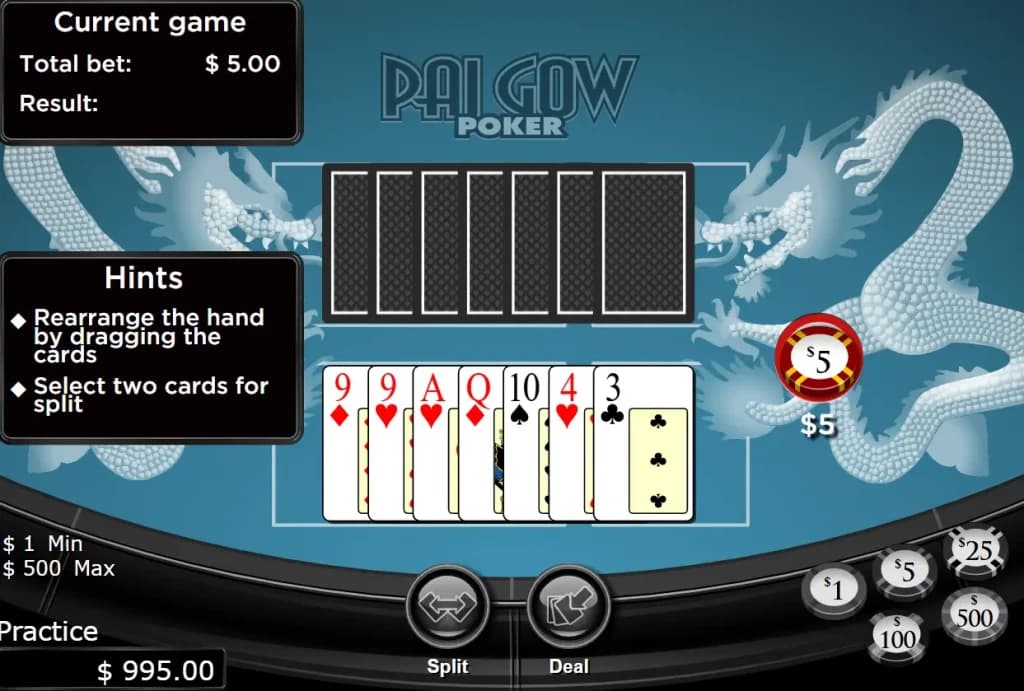
The game itself is straightforward. You are dealt seven cards and split them into a five-card hand and a two-card hand. Both need to beat the dealer’s for you to get paid.
This guide covers the rules, hand setting, the house way, the odds and payouts, and the decisions that matter. It assumes you know what a flush is and have never played this game.
What Is Pai Gow Poker? The Slow-Burn Card Game Worth Pulling Up a Chair For
Pai Gow Poker is a table game where you split seven cards into two poker hands, a five-card high hand and a two-card low hand, and play both against the dealer’s two hands.
It arrived on casino floors in the 1980s as a card adaptation of pai gow, a much older Chinese domino game. The two-hand structure came straight across; the poker rankings were added later.
The deck is 52 cards plus one joker, making 53. The joker is semi-wild, and the distinction matters. It can complete a straight, a flush or a straight flush. It cannot stand in for any card you like. Otherwise it counts as an ace and nothing else.
For a first-timer the appeal is what the game leaves out. No other players to read, no bluffing, no betting rounds. You place one bet, make one decision, and see the result. If you like that shape, three-card poker works on similar lines.
Pai Gow Poker Rules
To get paid you need to win both hands: your five-card hand must beat the dealer’s five-card hand, and your two-card hand must beat theirs. Win both and your bet pays. Lose both and it is gone. Win one and lose the other and the hand is a push, with your bet returned. That push is the outcome that defines the game, and it happens more often than either a win or a loss.
One rule governs the split: your five-card hand must be stronger than your two-card hand. Set it the other way round and you have a fouled hand, which loses the bet outright regardless of what the dealer holds. It is easier to avoid than it sounds, since a two-card hand can only ever be a pair or two unmatched cards.
Ties go to the dealer. If your two-card hand exactly matches the dealer’s, say both are ace-king, that is a copy and the dealer takes it. It applies to both hands and forms a real part of the house edge.
Winning bets carry a 5% commission, so a $10 win returns $9.50. That commission is how the house makes money on a game which pushes this often.
How to Play Pai Gow Poker, Step by Step
A round is short, and there is one decision inside it.
- Place your bet. One wager on the main game, within the table limits. There is nothing else you need to stake.
- Receive seven cards. They are dealt face down. The dealer also receives seven, which stay hidden until the showdown.
- Split them into two hands. Five cards into your high hand, two into your low hand. This is the decision. You want both hands strong enough to win rather than loading everything into one. A pair of kings in the back does you no good if your front hand is a seven and a three.
- Set both hands down. Place them in their marked positions, or the equivalent positions on screen.
- The dealer reveals and compares. The dealer’s seven cards are turned up and set by the house way, then each of your hands is compared against its opposite number.
Three outcomes are possible. Win both and you are paid even money less commission. Win one and lose one and the hand pushes. Lose or tie both and the bet is collected.
Pai Gow Poker Hand Rankings
The five-card hand uses standard poker rankings, with two wrinkles. The two-card hand is where new players hesitate, and it is simpler than it looks: it can only be a pair or two unmatched cards. A pair of sixes beats ace-king. There is nothing else it can be.
| Hand | What it is |
| Five aces | Four aces plus the joker. The strongest hand in the game, and only possible because of the joker |
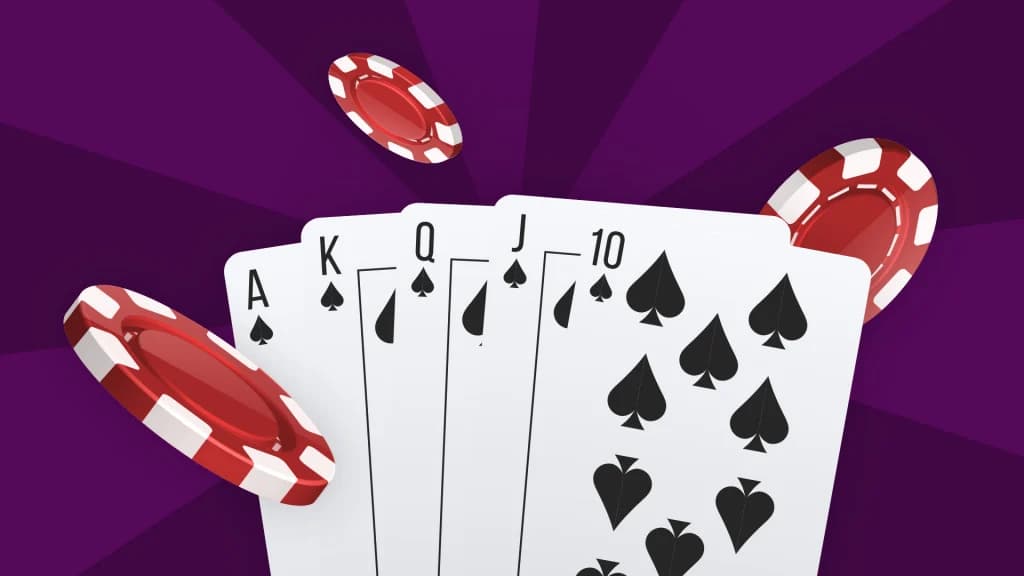
| Royal flush | Ten through ace, all one suit |
| Straight flush | Five cards in sequence, all one suit |
| Four of a kind | All four cards of one rank |
| Full house | Three of one rank and two of another |
| Flush | Five cards of the same suit, not in sequence |
| Straight | Five cards in sequence, mixed suits |
| Three of a kind | Three cards of one rank |
| Two pair | Two separate pairs |
| One pair | Two cards of the same rank |
| High card | No pair, no straight, no flush. Ranked by the highest card |
Five of a kind exists only because of the joker: four aces plus the joker acting as an ace, outranking everything else. No other five of a kind is possible. The other wrinkle is A-2-3-4-5, which under standard Nevada rules is the second-highest straight, below A-K-Q-J-10 but above K-Q-J-10-9. It catches out players who expect it to be the lowest, as it is in most poker variants.
Setting Your Hand the House Way
The house way is a fixed set of rules for splitting seven cards, and any player can ask the dealer to set their hand by it. Online there is usually a button that does the same.
It is not a beginner’s crutch. The dealer’s own hand is set this way on every round without exception, so using it puts you on the same footing as the house. Plenty of experienced players use it for most hands and deviate only on the close calls.
| Hand type | How the house way sets it | What it means for you |
| No pair | Highest card in the five-card hand, next two highest in the two-card hand | Nothing to build with, so the goal is a two-card hand strong enough to steal a push |
| One pair | Pair in the five-card hand, two highest remaining cards in the two-card hand | The standard hand. Your pair should win the back, so the front decides the round |
| Two pair | Usually split: higher pair in the five-card hand, lower pair in the two-card hand | A close call. Splitting gives two winning chances; keeping them together wins the back but abandons the front |
| Three of a kind | Kept together in the five-card hand, next two highest in the two-card hand | Strong back hand. Exception: with three aces, play one ace in the front |
| Straight or flush | Keep the five-card hand intact, play the two highest remaining cards in front | Unless breaking it gives a much stronger front without losing the back entirely |
| Full house | Split: three of a kind in the back, the pair in the front | A pair in the two-card hand is a powerful front, and trips usually still win the back |
| Four of a kind | Depends on rank. Low quads stay together, higher quads are split into two pairs | Splitting aces or kings gives you a pair in front and a pair behind, which wins both more often |
| Five aces | Split: three aces in the back, two aces in the front | Unless you also hold a pair of kings, in which case play the kings in front and keep all five aces together |
Three hands are close enough to be worth thinking about rather than defaulting. Two pair is the big one, and how you play it depends on how high the pairs are and whether you hold an ace for the front. Four of a kind is the second, where the answer shifts with the rank of the quads. A full house with a very low pair is the third.
Pai Gow Poker Odds, Payouts and Pushes
The push rate is what a session actually feels like. According to Wizard of Odds, the hand goes to a push 41.47% of the time, with the player winning 28.55% and losing 29.98%. In practice that means roughly two hands in every five end with your bet simply returned. Money moves slowly in both directions, which is why a modest stack lasts longer here than at almost any other table game.
Winning hands pay even money less the 5% commission. A $20 winning bet returns $20 minus $1, so you collect $19 in profit and take back $39. On a $10 bet the commission is 50 cents, which is why many players bet in multiples of $20 to keep the arithmetic clean.
The house edge is approximately 2.85% for a player who never banks, according to the same Wizard of Odds analysis. That figure is the share of every dollar wagered the house expects to keep over a very long run, so on $100 of bets the expectation is a loss of around $2.85. It is a long-run average, not a session forecast.
Pai Gow Poker Strategy Tips
Every decision in this game lives in how you split the seven cards. There is nothing else to get right, which makes the strategy unusually compact.
The joker earns most where it completes something. Use it to fill a straight or flush wherever possible, since those are worth far more than the ace it otherwise becomes. If it completes nothing, treat it as an ace, which often means putting it in the two-card hand.
Two pair comes up most often and separates good play from default play. Splitting them improves both hands at once, giving you a pair in front and a pair behind rather than a strong back and a weak front. The exception is when both pairs are low and you hold an ace: keeping them together and playing the ace in front can be better, since a low front pair is easily beaten anyway.
Sometimes the right play is aiming for the push rather than the win. With weak cards, splitting to give both hands a fighting chance beats loading everything into the back. A returned bet is a good outcome in a game that pushes two hands in five.
On bankroll: the low volatility means a smaller stack goes further here than at most tables, but the house edge still works on every hand. Set a session budget before you sit down and treat it as fixed. If gambling stops feeling like entertainment, the National Problem Gambling Helpline is free and confidential on 1-800-522-4700, or at ncpgambling.org. More in the guide to gambling responsibly.
Where to Play Pai Gow Poker Online

An online table suits this game well, because nothing hurries you. You can sit on a two pair decision as long as you want with no dealer waiting, which is exactly the environment for learning the splits properly.
Setting hands on screen is simple. Your seven cards appear, you tap or drag two into the low hand, and the remaining five form your high hand. There is a house way button for the default, and the game warns you before allowing a fouled hand. It plays the same on desktop and mobile. Pai Gow Poker online is there whenever you fancy a slower evening.
Ready to Split Your First Hand?
Low volatility, a push rate that keeps you at the table, and one decision per hand that actually matters. That is the whole appeal, and it is a rare combination. Play a few hands and let the rhythm settle before you worry about the close calls, because the game teaches itself faster than any guide can. The rest of the poker games online are waiting when you want a change of pace.
Frequently Asked Questions
How many decks do you need for Pai Gow Poker?
One deck of 52 cards plus a single joker, making 53 in total. The joker is semi-wild: it can complete a straight, a flush or a straight flush, and in any other situation it counts as an ace rather than a card of your choosing.
Is Pai Gow Poker a game of skill or luck?
Both, with luck doing most of the work. The cards you receive are entirely random, but how you split them into two hands is a real decision that affects your result. Good hand setting improves your outcomes measurably without ever overcoming the house edge.
What happens if I set my two hands the wrong way round?
That is a fouled hand, and you lose your bet outright regardless of what the dealer is holding. Your five-card hand must always outrank your two-card hand. Online games will warn you before allowing it, and at a live table the dealer will usually catch it.
Can I ask the dealer to set my hand for me?
Yes, just ask for the house way and the dealer will set it for you. It is a reliable default rather than a beginner’s option, because the dealer’s own hand is set by exactly the same rules on every round. Online, there is normally a house way button.
Why does the casino take 5% of my winnings?
The commission is the game’s built-in edge, and it is how the house profits from a game that pushes so often. On a $20 winning bet you pay $1, so you collect $19 in profit rather than $20. It applies only to winning bets, never to pushes.
What does pai gow actually mean?
It translates roughly as make nine, from the Chinese domino game the card version grew out of. In that older game, nine was the target score. The two-hand structure carried across to the poker adaptation even though the scoring did not.
Can I play Pai Gow Poker online for real money?
Yes, Pai Gow Poker is available at Cafe Casino on both desktop and mobile. Setting hands on screen means dragging or tapping two cards into the low hand, with the remaining five forming your high hand. A house way button sets the default split for you.
More Poker & Table Game Tips
August 28, 2026
Blackjack vs Poker – Which Card Game is Right for You?
Learn which game suits your strategy, skill level, and playing style best and boost your winning potential today

September 30, 2025
A Full House of Great Poker Movies
It’s safe to say poker and movies are a natural pair. Relive the best poker movies and discover some lesser-known ones with our poker film list.
March 4, 2025
How to Play 3-Card Poker (& Win)
Three card poker is a fast-paced blend of video poker and classic five-card poker. Discover how to play 3-card poker and strategies to win.
August 4, 2026
Roulette Strategy: Smarter Ways to Play the Wheel
Following a roulette betting strategy could help you stay in the game and win more. These are the top 10 roulette betting strategies and how they work.