
Illustrious 18: The Blackjack Deviations Chart, Explained
Picture a player at third base. Dealer shows a 10. The player looks at a hard 15 and stands. The table winces. The dealer flips a 6 underneath, making 16, then busts on the next card.
That player wasn’t guessing. They knew the true count was high enough to flip the basic strategy decision on that specific hand. They were playing from the Illustrious 18 – the 18 most valuable departures from basic strategy, each triggered by the Hi-Lo true count.
The Illustrious 18 refines basic strategy rather than replacing it. Basic strategy is still the default for every hand. These 18 index plays are the moments when the count tells you that the default is wrong – and a different decision is worth more.
What Is the Illustrious 18?
Donald Schlesinger first published the list in Blackjack Forum magazine in 1986, later expanding on it in Blackjack Attack: Playing the Pros’ Way. His work identified which playing deviations from basic strategy deliver the most value to a Hi-Lo card counter in multi-deck games.
A deviation is any hand where the count-aware decision differs from basic strategy. An index is the true count threshold at which that deviation kicks in. When the true count reaches the index, you make the deviation play. When it doesn’t, you fall back to basic strategy.
Thousands of playing situations exist in blackjack. Most deviation indices contribute almost nothing in practical terms. Schlesinger’s research found that 18 plays capture the large majority of the value available from playing changes. Learning those 18 – rather than hundreds of indices – gives a counter most of the gain at a fraction of the memorization cost.
Think of it like a greatest-hits album. You don’t need every track ever recorded – just the ones that account for most of what people actually listen to. The Illustrious 18 is that list. The Fab Four surrender plays are the bonus tracks.
The plays are ranked by value, with insurance at the top of the list.
What You Need Before Using the Chart

Three things need to be in place before the chart is useful. Without them, the index numbers are just numbers.
Start With Basic Strategy
Basic strategy is the mathematically correct decision for every hand combination, assuming no knowledge of the remaining deck composition. Every hand you play starts with it. The Illustrious 18 doesn’t overwrite basic strategy – it tells you which specific situations to override it, and only when the count says so.
If you’re not yet playing accurate basic strategy on every hand, memorize that first. Counting adds value on top of basic strategy. It doesn’t substitute for it.
Keep the Hi-Lo Running Count
The Hi-Lo system assigns a point value to every card:
- Cards 2-6: +1 (low cards, favor the dealer when they go)
- Cards 7-9: 0 (neutral, count doesn’t change)
- Cards 10, Jack, Queen, King, Ace: -1 (high cards, favor the player when they stay in the deck)
As cards are dealt, you add or subtract from a running total. A rising running count means more low cards have left the deck, and the remaining shoe is richer in high cards – which is good for the player. A falling count means the opposite.
Convert to a True Count
The running count alone isn’t enough. A running count of +8 in a one-deck game is very different from +8 in a six-deck game. The true count normalizes the running count per deck remaining.
Steps to calculate the true count:
- Estimate how many decks remain in the shoe. Look at the discard tray – if roughly three decks have been dealt in a six-deck shoe, about three decks remain.
- Divide the running count by decks remaining. Running count +6, three decks remaining: true count = +2.
- Round down (floor) to the nearest integer. +2.7 becomes +2. This is the standard convention for index play.
The index in the chart is that true count value. When the true count reaches or exceeds the index, the deviation applies.
The Illustrious 18 Chart
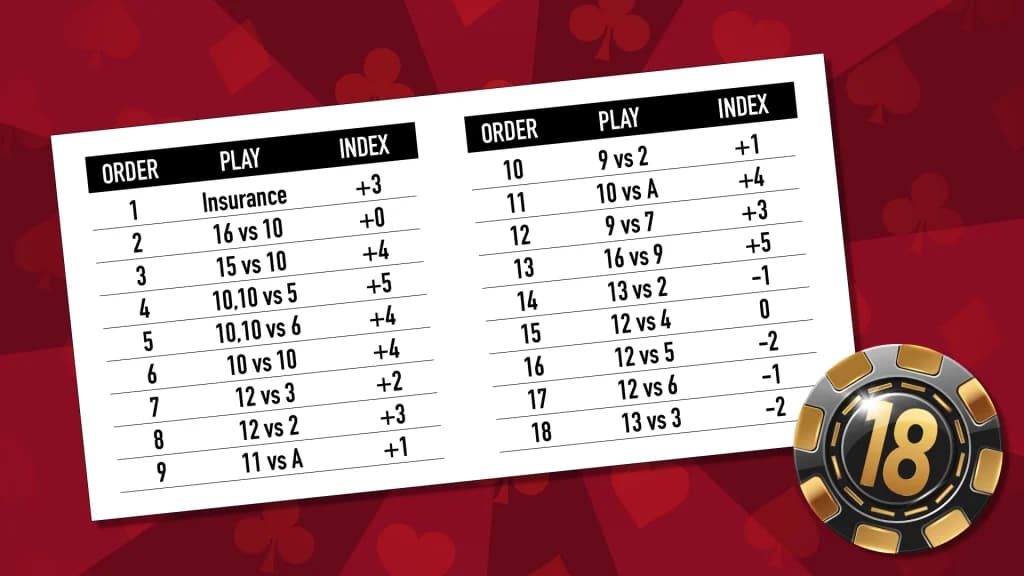
The chart below uses Hi-Lo indices for multi-deck games with the dealer standing on soft 17 (S17) and doubling after splits allowed (DAS). If your table uses different rules – particularly if the dealer hits soft 17 – some indices shift. A tip on that below the chart.
For stand and double plays: at or above the index, make the deviation play. Below the index, fall back to basic strategy. For split plays: at or above the index, split. The exception is 12 vs 4, which is a negative index – there, the deviation is to hit when the count drops below the index.
| # | Hand vs dealer upcrd | Index (true count) | At or above index | Below index |
| 1 | Insurance (vs dealer Ace) | +3 | Take insurance | Decline insurance |
| 2 | 16 vs 10 | 0 | Stand | Hit |
| 3 | 15 vs 10 | +4 | Stand | Hit |
| 4 | 10,10 vs 5 | +5 | Split | Stand on 20 |
| 5 | 10,10 vs 6 | +4 | Split | Stand on 20 |
| 6 | 10 vs 10 | +4 | Double | Hit |
| 7 | 12 vs 3 | +2 | Stand | Hit |
| 8 | 12 vs 2 | +3 | Stand | Hit |
| 9 | 11 vs Ace | +1 | Double | Hit |
| 10 | 9 vs 2 | +1 | Double | Hit |
| 11 | 10 vs Ace | +4 | Double | Hit |
| 12 | 9 vs 7 | +3 | Double | Hit |
| 13 | 16 vs 9 | +5 | Stand | Hit |
| 14 | 13 vs 2 | -1 | Stand | Hit |
| 15 | 12 vs 4 | 0 | Stand | Hit (at -1 or below) |
| 16 | 12 vs 5 | -2 | Stand | Hit |
| 17 | 12 vs 6 | -1 | Stand | Hit |
| 18 | 13 vs 3 | -2 | Stand | Hit |
Tip: Check your table rules before relying on any index. Deck count, H17 vs S17, and surrender availability all affect which indices apply. The chart above is built for multi-deck S17 games with DAS.
How to Read Each Row
Each row has four pieces of information: the hand you’re holding versus the dealer’s upcard, the index (the true count trigger), what to do when the true count is at or above that index, and what to do when it’s below. The index is the line. Above it, you deviate. Below it, you play basic strategy as normal.
What Happens Below the Index
For stand deviations (plays 2, 3, 7, 8, 13-18): when the count falls below the index, the fallback is to hit – that’s what basic strategy calls for on those hands. For double deviations (plays 6, 9, 10, 11, 12): when the count falls below, hit instead of doubling. For the pair split plays (4, 5): when below the index, stand on the 20 as basic strategy would have you do. For negative indices like 12 vs 4 (play 15), the deviation is to hit when the count drops below zero – at zero or above, basic strategy already says stand.
Do the Indices Change in H17 Games?
Yes, some do. When the dealer hits soft 17 rather than standing (H17 games), a handful of the Illustrious 18 indices shift, typically by one point. Insurance stays at +3. Several of the borderline stand decisions move slightly. If you’re playing at an H17 table, verify the specific H17 Hi-Lo indices against a published source for that rule set before relying on the standard chart above.
How to Use the Illustrious 18 at the Table
Back to the player at third base with hard 15 against a dealer 10. Why did they stand?
Because their true count was +4 or higher. Play 3 on the chart – 15 vs 10 – has an index of +4. At a true count of +4 or above, the deck is rich enough in high cards that standing becomes the better decision: the dealer is more likely to bust with a high card underneath, and hitting exposes the player to more bust risk. Below +4, basic strategy says hit.
The in-hand routine runs like this:
- Note the hand and the dealer upcard.
- Check whether this combination appears in the Illustrious 18.
- If it does, compare the current true count to the index.
- At or above the index: play the deviation. Below it: play basic strategy.
Two more quick examples. Play 2: 16 vs 10 has an index of 0. At a true count of zero or above, stand on 16 against a 10. Below zero, hit as basic strategy says. This is one of the most common index plays because 16 vs 10 comes up constantly. Play 1: Insurance against a dealer Ace at a true count of +3 or higher. Below +3, decline insurance as basic strategy dictates.
Tip: Learn the top-ranked plays first. Insurance (+3), 16 vs 10 (0), and 15 vs 10 (+4) appear most often and deliver the most value. Add the rest gradually. Practice with flashcards or in free play until the responses are automatic before applying them in a real session.
The Fab Four: Surrender Deviations
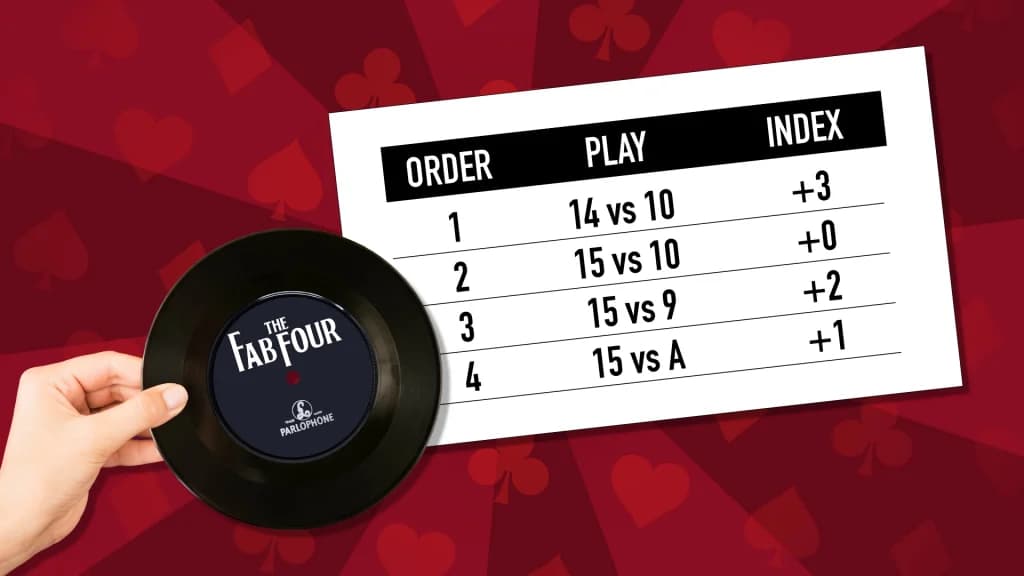
If the Illustrious 18 is the greatest-hits album, the Fab Four are the bonus tracks. They’re the four surrender deviations that complement the main chart – applicable only at tables where late surrender is offered.
Surrender lets you fold the hand after seeing your first two cards and the dealer upcard, returning half your stake. Basic strategy uses surrender on certain hands unconditionally. The Fab Four add four more situations where the true count makes surrender the right call.
| Surrender play (hand vs dealer) | Index (true count) | At or above index | Below index |
| 14 vs 10 | +3 | Surrender | Play basic strategy (hit) |
| 15 vs 10 | 0 | Surrender | Play basic strategy (hit) |
| 15 vs 9 | +2 | Surrender | Play basic strategy (hit) |
| 15 vs Ace | +1 | Surrender | Play basic strategy (hit) |
Surrender is not available at every table. Before adding the Fab Four to your session, confirm late surrender is offered at your specific game.
Can You Use the Illustrious 18 When Playing Online?
At a standard RNG (random number generator) online blackjack table, like when playing blackjack games online at Cafe Casino, counting is not possible. The virtual deck is reshuffled after every single hand, which means there is no running count to keep and no true count to calculate. The Illustrious 18 has no practical application in RNG play.
Live dealer blackjack is different. A real shoe is dealt to a cut card, which means the count carries from hand to hand between shuffles. The same counting principles apply. The practical difference is penetration – how deep into the shoe the cards are dealt before reshuffling. Many live dealer tables use a cut card at 50% or less of the shoe, which limits how often high true counts appear and reduces the value of index plays compared to a deep-penetration shoe in a land-based casino.
The Illustrious 18 chart is also a useful study tool for any player who wants to understand how deck composition affects decisions and looking to practice blackjack – even if they’re not counting. Working through the logic of why a high count changes a stand-or-hit decision builds a much deeper understanding of why basic strategy works the way it does.
No strategy makes any individual hand a guaranteed winner. Set a session budget before you play, treat blackjack as entertainment, and use free play to practice decisions before risking real money.
Key Takeaways
- Basic strategy first. The Illustrious 18 only overrides it in specific situations at specific true counts.
- The Hi-Lo true count is the trigger. Every index in the chart is a true count threshold – convert running count to true count before acting.
- Eighteen plays, most of the value. Schlesinger’s research identified these as the plays that deliver the large majority of gain from index play in multi-deck games.
- The Fab Four are an add-on. Four surrender deviations that complement the main chart where late surrender is available.
The chart is a way to sharpen decisions at the moments that matter most. Try the hands at Cafe Casino’s blackjack tables – practice the spot where 15 stands against a 10 until it feels completely natural.
Illustrious 18 FAQs
What is the Illustrious 18 in blackjack?
The 18 most valuable departures from basic strategy for a Hi-Lo card counter in multi-deck blackjack. Each play has an index – a true count threshold – and when the true count reaches that number, the deviation replaces the basic strategy decision for that hand.
Which Illustrious 18 play matters most?
Insurance is ranked first. At a true count of +3 or higher, the deck contains enough high cards (10-value and Aces) to make insurance a positive-expectation side bet. Below +3, basic strategy says decline it – and at most true counts in a live session, declining is correct.
Do I need to memorize all 18 plays at once?
No. Start with the top-ranked plays – insurance, 16 vs 10, and 15 vs 10 cover the most common and highest-value situations. Add the rest gradually as the earlier ones become automatic. Practicing with flashcards or simulation software in free play is the standard approach before bringing the chart to a real session.
Is counting cards with the Illustrious 18 illegal?
Keeping a mental count is not illegal – it uses no device and requires no assistance. Casinos are private businesses, however, and they can ask a player to stop playing blackjack, reshuffle more frequently, or leave the premises if they suspect counting. No laws are broken, but there’s no right to continued play at any specific casino.
Does the Illustrious 18 work in single-deck or H17 games?
The standard chart above is built for multi-deck S17 games with DAS. Some indices shift in single-deck or H17 games. Before applying the chart in a different rule set, verify the specific indices against a published source for those exact conditions.
How much does the Illustrious 18 lower the house edge?
For an accurate counter, index play from the Illustrious 18 provides a modest long-run improvement on top of basic strategy alone. The exact benefit depends on the game conditions, penetration and accuracy of the count. It sharpens decisions at key moments – it doesn’t guarantee a profit or eliminate the house edge on its own.
What is the difference between the Illustrious 18 and the Fab Four?
The Illustrious 18 covers stand, double and split deviations. The Fab Four are four additional surrender deviations – hands where the true count makes surrendering the correct play. They complement the main 18 at tables that offer late surrender, and are worth learning after the core chart is solid.
More Blackjack Guides

November 5, 2026
Blackjack Tournament Strategy: Play the Table, Not the Dealer
The goal in a blackjack tournament is to end up with more chips than the other players. Get our winning strategy for your next tournament.

November 5, 2026
What Is DAS in Blackjack? Double After Split, Explained
What Is DAS in Blackjack? Double After Split, Explained What is DAS in blackjack? DAS stands for “Double After Split.” You’ll encounter this rule on an online blackjack paytable or rules placard if you’re playing in person. You’ll also see it factored into strategy charts, which is a key focus of this DAS guide. We’ll […]

August 28, 2026
Blackjack vs Poker – Which Card Game is Right for You?
Learn which game suits your strategy, skill level, and playing style best and boost your winning potential today
July 28, 2026
The 1-2-3-5 Blackjack Betting Strategy
The blackjack 1-2-3-5 betting system aims to capitalize on winning streaks and minimize losses – but does it really work? Discover tips to use it here.

August 4, 2026
Blackjack Bankroll Management: How to Set Limits, Size Your Bets, and Play Longer
Blackjack Bankroll Management: How to Set Limits, Size Your Bets, and Play Longer Pull up a chair. You’ve picked your table, you know your cards, and you’ve got one more thing to sort out before the first hand: a plan for your money. That’s blackjack bankroll management in a nutshell, not a high-roller system, not […]