Double Deck Blackjack Strategy: Your Chart and Playbook for Two-Deck Tables
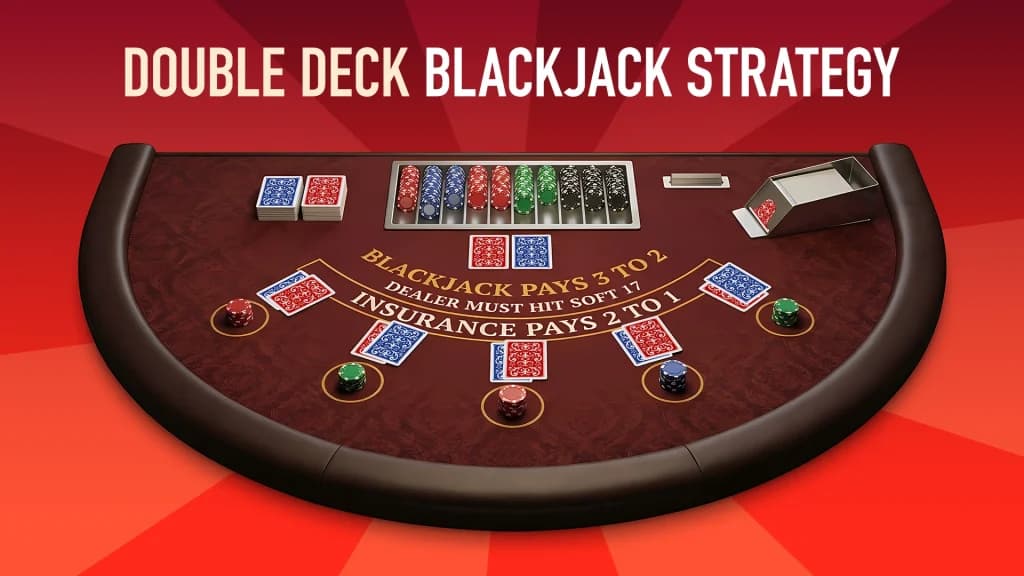
With only two decks in double-deck blackjack, every card dealt takes a bigger bite out of what’s left in the shoe, and it has a bigger effect on the odds.
Double-deck blackjack strategy has a few different moves from its six-, eight-, or even single-deck counterparts, thanks to a new balance of 10-value and low cards. The house edge is lower than six- or eight-deck blackjack, but it still hangs on like that one strand of silk on an ear of corn. Just can’t get rid of it.
Pay double attention to this one, because we’ll be covering the different decisions and the rules that affect the house edge. You’ll also get a free double-deck blackjack strategy chart to use as your cheat sheet.
Table of Contents
- What makes double deck blackjack different
- Check the rules before playing
- Double deck blackjack strategy chart
- Double deck vs 6-deck strategy differences
- Double deck house edge and odds
- Putting strategy into practice
- Start playing
- FAQs
What Makes Double Deck Blackjack Different
Double–deck blackjack is played with two standard 52-card decks, for a total of 104 cards. For comparison, a six-deck shoe contains 312 cards, and an eight-deck shoe has 416. (And you thought 52-card pickup was bad.)
Before any cards are drawn, the probabilities of drawing any single card are the same, regardless of how many decks are used in blackjack. You always have a 30.8% chance of drawing a ten-value card, whether you’re playing with one deck, two decks, or seven thousand (please don’t tell your older sibling about that one).
But once the dealer starts dealing, each removed card changes the odds of what you’ll draw next, even when you compare single-deck vs. double-deck blackjack. That small shift is enough to turn a “hit” into a “double” in a few close calls.
In a land-based casino, double-deck blackjack is often dealt as a pitch game, meaning the dealer holds the cards and “pitches” them face down to you. In a shoe game, the dealer pulls cards from a box called a shoe and deals them to the players face up. In online blackjack, the software deals from two virtual decks.
Check the Table Rules Before You Sit Down
The first step in following the optimal double-deck blackjack strategy is to verify that particular game’s rules, as the correct strategy chart depends on them.
The chart below demonstrates how different rules affect your strategy.
| Player-friendly version | Less favorable version | What it changes for you | |
| Blackjack payout (3:2 vs 6:5) | Blackjack pays 3:2 | Blackjack pays 6:5 | On a $10 bet, a natural blackjack wins $15 at 3:2 or $12 at 6:5. |
| Dealer soft 17 (S17 vs. H17) | Dealer stands on soft 17 (S17) | Dealer hits soft 17 (H17) | Hitting gives the dealer a chance to improve hands like A-6. |
| Doubling options | Double on any two starting cards | Double only on certain totals, such as 10 or 11 | With restrictions, you can’t double in ideal spots like a hard 9 against a dealer 2–6. |
| Double after split (DAS vs NDAS) | You can double after splitting (DAS) | You can only double on your initial two cards (NDAS) | With DAS, you can split 8s and double again if you draw a 3 to take advantage of 11. |
| Surrender | Late surrender available | No surrender | After the dealer checks for blackjack, you can fold a weak starting hand and get half your bet back. |
| Resplitting aces | You can split aces again if you draw another ace | You can split aces only once | If one of your split aces draws another ace, you can split that pair again and play three hands instead of two. |
IMPORTANT: When given the choice, a 3:2 table with less favorable rules is always better than a 6-to-5 blackjack table with more favorable rules.
Your Double Deck Blackjack Strategy Chart
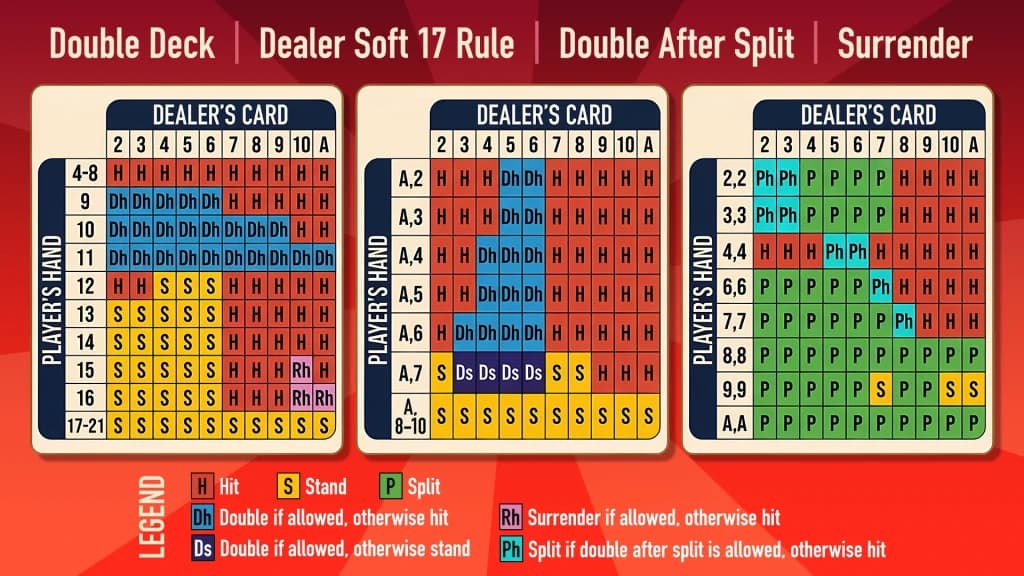
The double-deck blackjack chart below is your official cheat sheet for playing with two decks. The chart follows rules for a 3:2 blackjack payout, and the dealer stands on soft 17 (S17).
How to Read the Chart
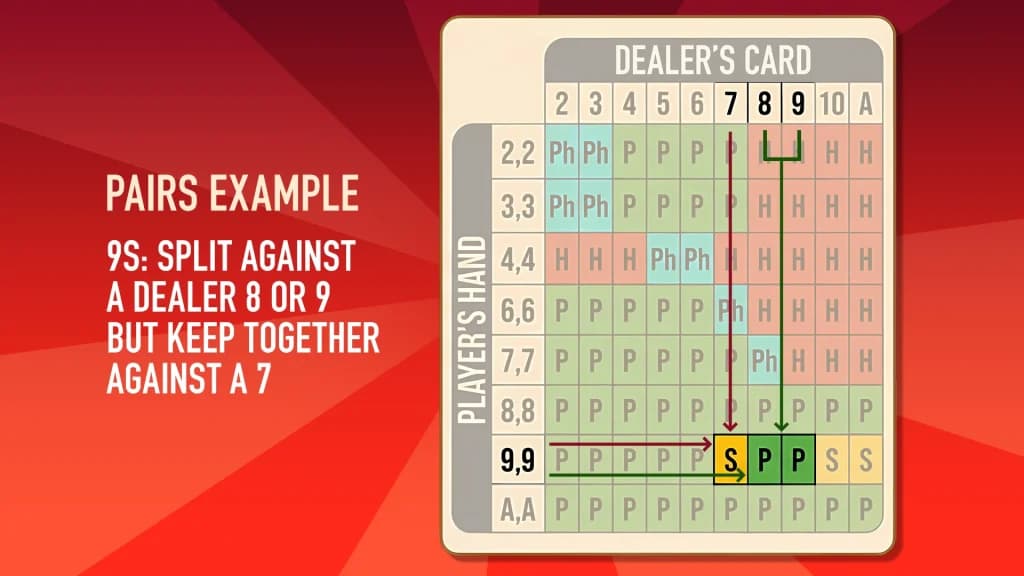
- Find your hand down the left side. Check the pairs section first if you have a pair. If your hand contains an ace that can count as 11 without going over 21, refer to the soft totals. Use the hard totals if you have no ace or your ace has to count as 1. EX: Ace-6 is a soft 17. Ace-6-10 is a hard 17.
- Find the dealer’s upcard across the top. Follow your row across and the dealer’s column down until they meet. That square tells you what to do.
Hard Totals
- Hard 9, 10, and 11. Double a 9 against 2 through 6 and a 10 against 2 through 9. Double an 11 against any upcard. Hit if you can’t double.
- Hard 12. Stand against 4 through 6. Hit against everything else.
- Hard 13 through 16. Stand against 2 through 6 and let the dealer take the risk of busting. Hit against 7 through Ace.
- Hard 17 or higher. Stand.
Soft Totals
With soft 13 through 17, look for chances to double against low dealer cards. The lower your total, the fewer chances you’ll get. For example, with Ace-5 against a dealer 4, double if you can. If you can’t, hit. Even if you draw a 10, your ace drops to 1, and you still have 16.
Soft 18 has its own set of rules. Double against 3 through 6 and stand if you can’t double. Stand against 2, 7, or 8, and hit against 9, 10, or Ace. With soft 19 or higher, stand.
Pairs
Always split aces and 8s. Don’t split 5s; a hard 10 is a decent hand to play as-is. For the same reason, keep two 10s together and stand on 20.
For the other pairs, check what the dealer shows. With the double-deck blackjack rules in our chart, you can split 6s against a 7 and 7s against an 8. Then there are 9s, which you split against a dealer 8 or 9 but keep together against a 7.
You don’t have to memorize everything all at once. Give yourself time to learn those close calls with our guide on how to memorize blackjack basic strategy.
Double Deck vs. 6-Deck Blackjack: Where the Strategy Changes
Even though the odds are slightly different with double-deck vs. 6-deck blackjack, the strategy is mostly the same, with no major changes. You won’t need to sell the house and move to Nebraska or anything, which is nice.
Only four key decisions change between the two, assuming the dealer stands on soft 17 (S17).
Hard 9 against a dealer 2. Double with two decks and hit with six. The low cards you can already see leave a slightly higher share of 10-value cards in the smaller pack, giving you a better shot at drawing to 19.
Hard 11 against a dealer Ace. Double with two decks and hit in a six-deck game. It’s a close call, but with two decks, the chance of drawing a 10-value card for 21 is enough to make doubling worthwhile.
Pair of 6s against a dealer 7. Split with two decks and hit with six. Splitting gives you two chances to build from a 6, and being able to double on either new hand tips the decision toward splitting.
Pair of 7s against a dealer 8. Split with two decks and hit with six. Starting two fresh hands with 7 gives you a chance to turn a hard 14 into stronger totals, some of which might be good enough to double.
| Dealer Upcard | Double deck play | 6-deck play | |
| Hard 9 | 2 | Double if allowed; otherwise, hit. | Hit |
| Hard 11 | Ace | Double if allowed; otherwise, hit. | Hit |
| Pair of 6s | 7 | Split if double after split is allowed; otherwise, hit | Hit |
| Pair of 7s | 9 | Split if double after split is allowed; otherwise, hit | Hit |
Double-Deck Blackjack House Edge and Odds
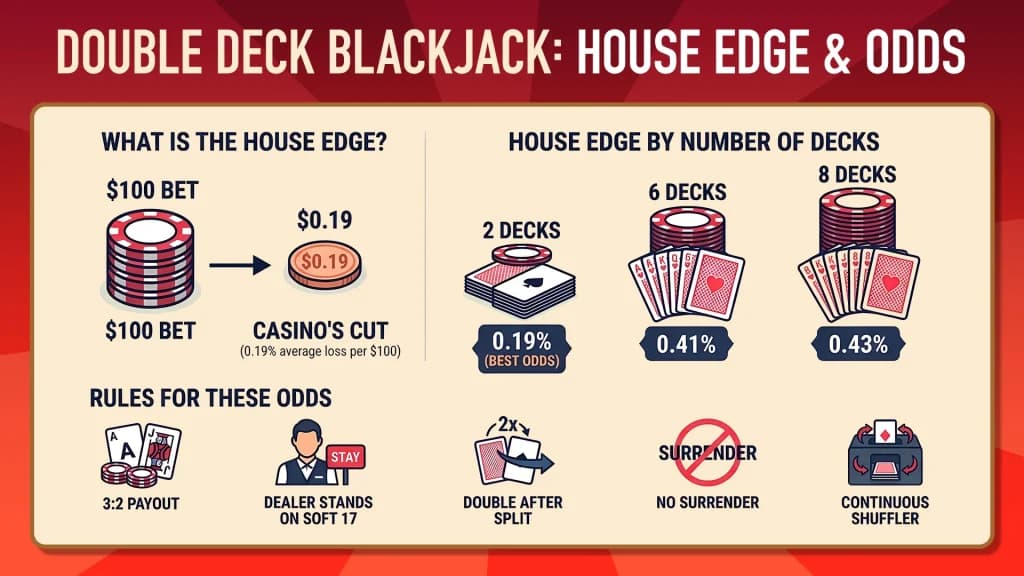
The house edge is the casino’s cut; casinos and diners have to keep the lights on just the same. The house edge tells you, on average, how much the casino keeps per dollar you spend. A 0.19% house edge translates to an average loss of $0.19 per $100 over many hands.
With basic strategy, the mathematician behind the gambling statistics website, Wizard of Odds, calculates that double-deck blackjack has a house edge of around 0.19%. Six decks fall around 0.41%, and eight decks sit at 0.43%.
In all three examples, blackjack pays 3:2, the dealer stands on soft 17, you can double after splitting, there’s no surrender, and the cards are dealt with a continuous shuffler.
Change just one measly rule, and the house edge changes, too, mostly for the worse.
If the dealer hits on soft 17 in double-deck blackjack, the house edge rises to 0.39%. If they stand on soft 17 but blackjack pays 6:5, the house edge is a whopping 1.56%. That’s not high for casino games in general, but it’s a Super Mario-sized jump from 0.19%.
Even with the most rock-bottom double-deck blackjack house edge, the casino will still have the advantage over time, and no strategy can guarantee a win.
Putting Your Strategy into Practice
Once you know your way around a chart, the table is a natural next step.
Practice Before You Play for Real
Open up a blackjack game in Practice Play (demo mode) before you bet real money. Keep the chart open while you play and practice until the moves feel as natural as Bruno Mars’ shoulder rolls in Uptown Funk, and you split 7s against an 8 without looking.
For more ways to drill the tricky hands, see our guide on how to practice blackjack.
Skip Insurance and Side Bets
If there’s one piece of wisdom we could impart to you today, it would be to skip blackjack insurance and side bets. That, and to taste the salsa before you dump it on the taco. Trust us.
When the dealer shows an ace, blackjack insurance is a bet that their hidden card is worth 10. It pays 2:1, but the dealer turns over a 10-value card too rarely to make the bet worthwhile.
Other side bets have even rarer outcomes and carry a much higher house edge than the main game, so they’re not worth it either.
Card Counting at Online Tables
In order to count cards, you need to keep track of cards that are out of play. If the game reshuffles the virtual decks after every hand, that information resets every round, and counting cards is pointless.
Your best strategy is to use a basic strategy chart when you play Double-Deck Blackjack online. Don’t overcomplicate it—the decisions are already there.
Set a budget before you sit down and play only with money you can afford to lose. For confidential support in the U.S., call or text the National Problem Gambling Helpline at 1-800-MY-RESET (1-800-697-3738) or visit NCPGambling.org.
Pull Up a Chair at the Two-Deck Table
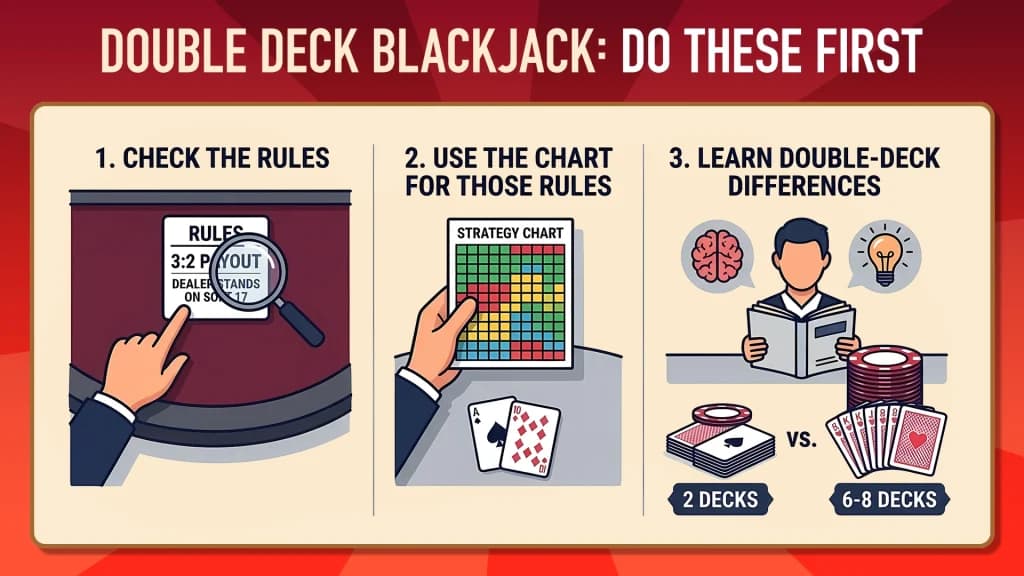
The next time you sit down at the double-deck blackjack table, always do these three things first:
- Check the rules
- Use the chart for those rules
- Learn the handful of differences with a double-deck
If you’re not busy, how ‘bout right now? We have a freshly buffed table where you can play blackjack games online right here at Cafe Casino. Can we grab you a drink?
Double Deck Strategy FAQs
Is double deck blackjack better than 6-deck blackjack?
Yes, having two decks instead of six or eight slightly lowers the house edge, assuming all other rules are the same. That said, a 6:5 table vs. a 3:2 table cancels out that advantage.
Should you hit a 14 against a dealer 2 in double-deck blackjack?
You should stand on 14 against a dealer 2. A 2 is a weak upcard, so you’re better off letting the dealer draw and risk busting instead of hitting and risking a bust yourself.
Should I double down on a 12?
No. With a hard 12, stand against a dealer 4, 5, or 6. Hit against a 2, 3, or anything from 7 through Ace.
Should you hit a 15 against a dealer 10?
Surrender if it’s allowed; otherwise, yes, you should hit. A hard 15 against a 10 is a tough spot, but if you can’t surrender, it’s best to fight back and try to improve your hand.
Does the strategy chart change if the dealer hits soft 17?
Yes. For example, at a two-deck table where the dealer hits soft 17, the correct move is to double a soft 18 against a 2 or a soft 19 against a 6. If the dealer stands on soft 17, you would stand on both instead. Check the rules above the strategy chart before you use it.
Can you count cards in online double-deck blackjack?
Online blackjack games reshuffle and reset the decks after each hand, rendering card counting useless because the cards you saw last round will tell you nothing about what’s coming next. Basic strategy is more effective at reducing the house edge.
What is the house edge in double-deck blackjack?
The house edge for double-deck blackjack is about 0.19% when you play with basic strategy, blackjack pays 3:2, double after splitting is allowed, and the dealer stands on soft 17. The house edge rises slightly if any of these rules are changed.
More Blackjack Guides
November 10, 2026
Illustrious 18: The Blackjack Deviations Chart, Explained
The Illustrious 18 chart tells card counters when to make the optimal move. Learn how the chart works and how to squeeze out every last drop of optimal play.
November 5, 2026
What Is DAS in Blackjack? Double After Split, Explained
What Is DAS in Blackjack? Double After Split, Explained What is DAS in blackjack? DAS stands for “Double After Split.” You’ll encounter this rule on an online blackjack paytable or rules placard if you’re playing in person. You’ll also see it factored into strategy charts, which is a key focus of this DAS guide. We’ll […]

November 5, 2026
Blackjack Tournament Strategy: Play the Table, Not the Dealer
The goal in a blackjack tournament is to end up with more chips than the other players. Get our winning strategy for your next tournament.

July 21, 2025
Ace Up Your Sleeve: How to Play a Blackjack Soft 16
With a soft 16 in blackjack, the trick is considering the dealer’s upcard before making your move. Learn how to handle a soft 16 for your best winning chance.